


A brand governance framework is the set of decision rights, rules, workflows and tools that controls how your brand is used by everyone who touches it. For a brand that sells through dealers, franchisees, distributors or agents, it answers four questions: who owns the brand, who can change it, who approves local work, and how you know the rules are being followed. This guide walks through the parts of a working framework, how to match it to your channel structure, and how to roll it out in 90 days.
TL;DR
- A framework has five parts: people and decision rights, standards, approval workflows, tools, and measurement.
- Govern by risk tier. Pre-approve routine work and send only high-stakes work to manual review.
- Match the level of control to how interdependent your units are. Franchise networks need tighter central rules than loosely connected offices.
- Put brand compliance into incentives, or it stays a marketing-only problem.
- Roll out in three 30-day phases: audit, standardize, then launch and measure.
Table of Contents
- What a brand governance framework actually is
- The five parts of a working framework
- Choosing how tight to make it
- Make compliance everyone’s job
- Governing AI-generated content
- A 90-day rollout plan
- Common mistakes
- Our perspective
- Where GearBox® fits
- FAQ
- Sources
What a brand governance framework actually is
Most definitions stop at “consistency.” That undersells the job. Governance is an operating system for the brand: it says who may make which decision, with what inputs, and how fast. A brand guidelines PDF is one input to that system. It is not the system.
The distinction matters most when you market through other people. A corporate team with one design studio can enforce standards by walking down the hall. A manufacturer with hundreds of dealers, or a restaurant brand with franchisees in every state, cannot. Local partners need to market quickly, and they will build their own materials if your process is slow. Governance that ignores that pressure produces workarounds, not compliance.
If you also see this called a brand governance model, it is the same idea seen from the structure side: who sits where, and who decides what. The framework includes the model, plus the rules and tools that make it run.
The five parts of a working framework
1. People and decision rights
Name a single brand owner, usually a CMO or head of brand, who makes the final call when something cannot be settled lower down. Without that, every disagreement becomes a negotiation.
Then add a forum for cross-functional disputes. Research on aligning brands across organizational boundaries describes how leading organizations use global brand councils: committees drawn from key business units and regions that set strategy, settle disputes and keep policy aligned with local requirements. For a channel brand, a council might include marketing, sales, legal, a few top-performing dealers or franchisees, and the person who runs partner programs.
Write the decision rights down. A simple table does it:
| Decision | Decides | Consulted | Informed |
|---|---|---|---|
| Logo, color, typography changes | Brand owner | Brand council | All partners |
| New campaign template | Brand team | Regional leads | Partners |
| Local ad using approved template | Partner (pre-approved) | None | Brand team via reporting |
| Local ad with custom copy or imagery | Brand team | Legal if claims involved | Partner |
| Co-branded material with a third party | Brand owner and legal | Partner manager | Brand council |
2. Standards that people can use
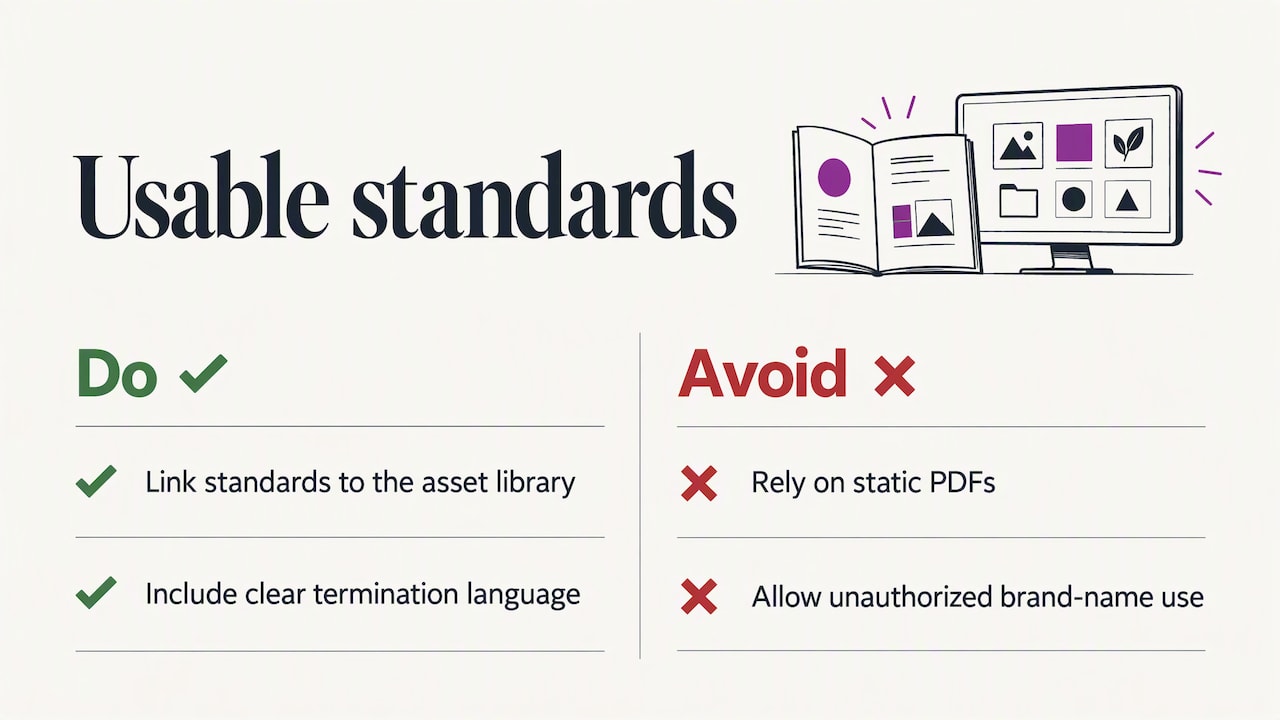
Standards cover visual identity, voice, claims, logo clearances, photography, and how partners may name themselves and use the brand online. The most common failure is a static PDF that is out of date the week after it ships. Better standards live where people work: linked to the asset library, so when a logo or template is updated centrally, partners see the current version and nothing else.
Standards for partner relationships need legal backing too. GE HealthCare’s channel partner co-branding guidelines are a useful public example: they define hierarchical branding roles for host and guest brands and set usage limits, so partners do not imply endorsements or use brand names in unauthorized ways. Build the same protections into partner agreements, including clear termination language. Our guide to co-branded marketing assets for channel partners covers how to give partners flexibility inside those limits.
3. Approval workflows tiered by risk
Reviewing everything is the fastest way to build a bottleneck. Sort requests into tiers instead:
- Tier 1, self-service. Locked templates where partners change only approved fields: name, address, phone, offer dates. No review needed.
- Tier 2, light review. Custom copy or images on approved layouts. One reviewer, a defined turnaround.
- Tier 3, full review. New claims, regulated language, co-branded work with another company, crisis communications. Brand council or legal signs off.
The goal is to move from checking every file to a guardrail-and-template model, where the brand team spends its time on exceptions. Set a service-level target for each tier and publish it. Partners tolerate rules far better when they know a Tier 2 request is answered in, say, two business days. For the mechanics of routing and escalation, see our piece on approval workflow software for distributed marketing teams.
4. Tools and technology
A framework without tooling depends on people remembering rules. The core stack for a channel brand usually includes:
- A digital asset management system as the single source of truth for approved logos, imagery and templates. Our digital asset management at scale guide and the article on building a brand asset library go deeper.
- Template-based campaign tools so local partners can personalize without redesigning.
- Approval routing with audit trails.
- Fund and order tracking, because co-op and market development dollars are one of the strongest levers for compliance: partners follow the rules to get reimbursed.
- Reporting on usage, approvals and compliance by location.
5. Measurement and audit
What you do not measure will drift. Track a small set of numbers: approval turnaround by tier, the share of materials created from approved templates, compliance rate by region or partner, and rework rate. Review a sample of live local marketing on a schedule. Our guide to brand compliance monitoring across locations lays out audit methods. For the business case behind these numbers, this overview of why brand consistency matters for growth is a helpful companion.
Choosing how tight to make it
There is no single correct level of control. A 2026 study in the European Journal of Operational Research on multi-unit organizations frames the choice as a trade-off between performance and standardization. Its finding, in short: where units are highly interdependent, as in global franchise networks, strict central governance is often needed. Where units are more independent, peer knowledge sharing and communication networks can deliver standardization more effectively than top-down control alone.
In practice that gives you three rough models:
| Model | Fits | Trade-off |
|---|---|---|
| Centralized | Franchises, regulated industries, banks with many branches | Highest consistency, risk of slow approvals |
| Federated | Distributors and dealers with regional marketing leads | Balanced, needs strong regional owners |
| Community-led | Independent agents and advisors with little shared operation | Fast and flexible, weaker consistency |
Most channel brands end up with a hybrid: fixed rules for logo, claims and legal language, and flexibility for local offers, imagery and channel choice. Our article on global brand control without losing local impact explores that balance, and brand consistency across global markets covers language and regional differences.
Make compliance everyone’s job
Brand drift is often an incentive problem, not a knowledge problem. The same alignment research notes that leading companies restructure performance incentives to include brand compliance measures, so consistency becomes a shared managerial goal rather than something marketing nags about. For channel partners, the equivalent is tying access to funds, programs or preferred status to following the rules. A dealer that gets co-op reimbursement only for approved, compliant materials has a clear reason to use the templates. See how this works in practice in our co-op fund management strategies.
Governing AI-generated content
AI tools now produce copy and images at a speed no review team can match, and they create a new kind of risk. A 2026 paper in Business Horizons describes agentic brand drift: a gradual divergence between the identity you intend and what AI systems produce. The authors argue that conventional governance frameworks such as ISO/IEC 42001 can miss it because they govern system behavior, not coherence of meaning.
Practical steps for your framework:
- Define which content types AI may draft and which it may not.
- Require human review for high-stakes content, such as claims, pricing and crisis messaging.
- Feed AI tools only approved assets, voice rules and templates.
- Add AI-origin content to your audit sample.
A 90-day rollout plan
You do not need a year-long program. A three-phase plan gets a working framework in place and produces baseline data.
Days 0 to 30: audit and align
Inventory existing guidelines, templates and assets. Sample what partners are actually using in the market. Identify who makes brand decisions today, formally and informally, and where approvals stall. Name the brand owner and form the council.
Days 30 to 60: standardize and systematize
Consolidate guidelines into one living source. Retire duplicates. Build templates for the most frequent partner requests, define the three approval tiers, and set the turnaround targets. Draft the legal language for co-branding and partner agreements.
Days 60 to 90: launch and measure
Roll out to a pilot group of partners first: one region, one dealer group or one franchise cohort. Train them, collect friction points, fix them, then expand. Capture baselines for approval time, template use and compliance rate so later improvement is visible.
Common mistakes
- Policing instead of enabling. If the framework only says no, partners route around it.
- One approval path for everything. A holiday promotion should not wait behind a legal review.
- No owner. Councils advise; someone must decide.
- Static guidelines. Anything not linked to the current asset library is stale.
- No consequences or rewards. Rules without incentives are suggestions.
- Ignoring the partner’s job. A local owner is selling this week. Give them speed and they give you compliance.
Our perspective
We have spent more than 20 years building marketing logistics for brands that sell through other people, and one pattern holds across industries: governance succeeds when it makes the compliant path the easy path. Corporate wants control of the brand and the budget. Local partners want to launch a promotion today. Those goals only conflict when the process forces a choice.
That is why we built GearBox® around one login for campaigns, vendors, co-op funds, orders and brand assets. When approved templates, approval hierarchies and fund reimbursement sit in the same place, the rules stop being a separate chore. Partners use the approved materials because that is where the tools and the money are. Brand teams see what is happening across the network without chasing it.
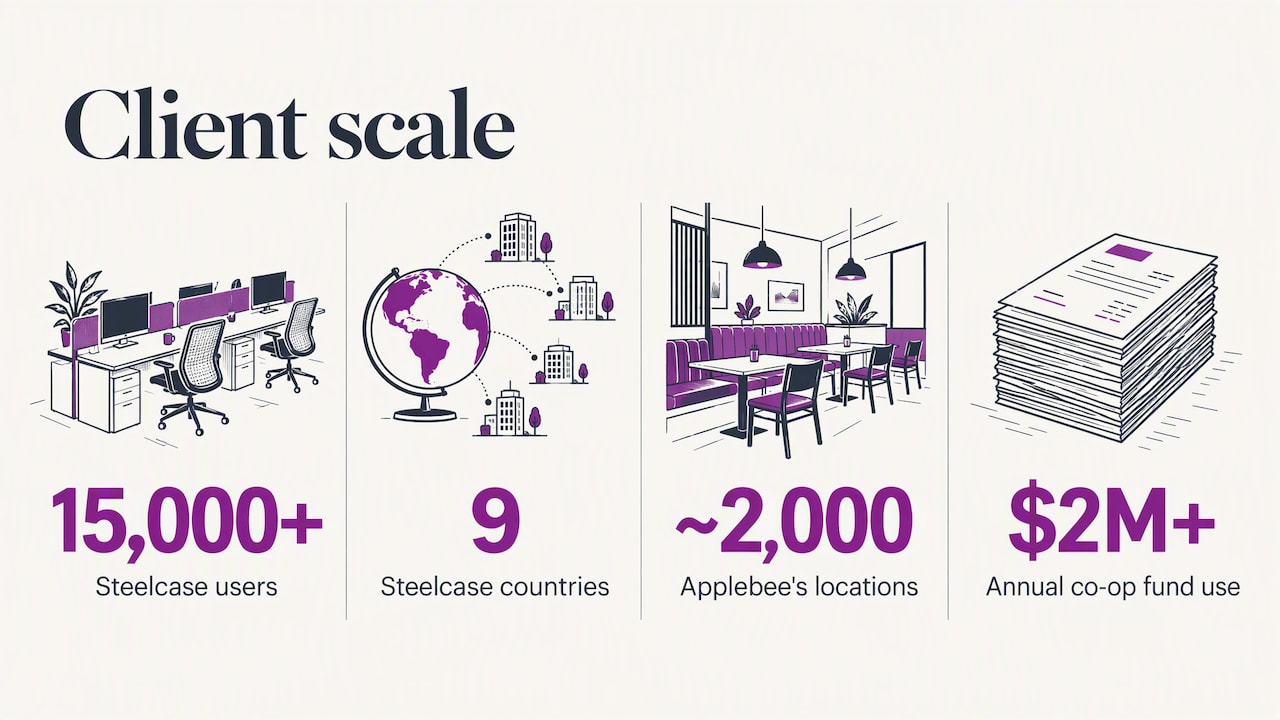
We have seen this at scale. Steelcase runs GearBox with more than 15,000 users in nine countries. Applebee’s automates menus across nearly 2,000 locations. SRS Distribution adds more than $2 million a year in co-op fund use across 70+ vendors. Our advice is to start with tiered approvals and a single source of truth for assets. Those two changes remove most of the friction that causes drift.
— Client
Where GearBox® fits
If your brand runs through dealers, distributors, franchisees, agents or advisors, GearBox® puts the framework above into one platform: asset management that integrates with Adobe DAM and Widen, approval hierarchies, Converge® for global-to-local marketing, co-op and MDF fund management, and analytics, with support for multilingual and multicurrency programs. See how it works for multi-location businesses, or schedule a demo to walk through your own channel structure.
FAQ
What is the difference between brand guidelines and brand governance?
Brand guidelines describe how the brand should look and sound. Governance is the system that makes people follow them: decision rights, approval workflows, tools and measurement. Guidelines are one component. Without governance, they tend to be ignored or go stale.
What is an example of a brand governance model?
A common one is a federated model. A central brand owner sets the rules for logo, claims and legal language, regional leads manage local needs, and partners use pre-approved templates for routine work. Only exceptions go to the brand council or legal for review.
Who should own brand governance?
A single executive, usually the CMO or head of brand, should own it, supported by a cross-functional council. Marketing runs day-to-day operations, but sales, legal and partner programs need seats at the table. Shared incentives help make it more than a marketing task.
How long does it take to implement a brand governance framework?
A workable first version can be live in about 90 days if you pilot with one group of partners. Expect to keep refining it as you gather data on approval times and compliance. Full network adoption takes longer, depending on the number of partners.
Sources
- Brand alignment across organisational boundaries
- Conformity: Resolving the trade-off between performance and standardization in multi-unit organizations
- Agentic brand drift
- GE HealthCare Channel Partner co-branding guidelines
