



Building products marketing is the work of getting a product specified by architects and engineers, stocked by distributors, and sold by dealers and contractors, all under one consistent brand. Most manufacturers do not sell directly to the person who installs their product. That means your marketing succeeds or fails in other people’s hands: the distributor’s counter, the dealer’s website, the contractor’s truck wrap. The brands that grow are the ones that make it easy for every one of those partners to market well, without losing control of the message or the budget.
This guide covers who you are actually marketing to, what each group needs, where manufacturers lose money, and how to run a program that holds together across hundreds or thousands of local partners.
TL;DR
- Building products are sold through a chain: specifiers, distributors, dealers, contractors and owners. Each link needs different content and a different reason to choose you.
- For architects and engineers, technical data (BIM objects, specifications, code reports) is the product. Make it easy to find and download.
- Distribution is consolidating and still partly analog, so plan for counter sales and rep quotes as well as digital channels.
- Co-op and market development funds are your best lever over local marketing, but only if partners can claim and use them without friction.
- A single platform for assets, campaigns, funds, vendors and orders keeps corporate in control while local partners move fast.
Table of Contents
- Who you are really marketing to
- Start with the specifier: technical data is the product
- Understand the distribution you depend on
- Share of voice: why smaller brands have to spend smarter
- Make co-op and MDF funds work for you
- Global-to-local: keep the brand intact at the edge
- Perspective: the problem is logistics, not creativity
- Run a practical 90-day plan
- Measure with the 1% rule
- Where GearBox fits
- FAQ
- Sources
Who you are really marketing to
A roofing shingle, a composite deck board or a commercial ceiling system passes through many hands before it is installed. A fair map of the chain looks like this:
| Audience | What they decide | What they need from you |
|---|---|---|
| Architects, engineers, specifiers | Which products go into the design and spec | BIM objects, spec sections, test and code-compliance documents |
| Distributors and wholesalers | What they stock and push | Margin, availability, training, co-branded sales tools |
| Dealers and retailers | What they recommend and promote | Ready-to-use campaigns, local ads, point-of-sale materials |
| Contractors and installers | What they buy and install | Fast quotes, warranty clarity, leads, proof of performance |
| Builders and homeowners | What they approve or request | Visual proof, brand trust, a way to find a local pro |
Most weak building products marketing treats this as one audience and runs one campaign. The strong programs write a distinct message for each link, then make sure the links all point at the same brand.
Start with the specifier: technical data is the product
For architects and engineers, a brochure is a nice extra. The actual product is the data they can drop into a model and a specification. A 2025 BIMobject report of 1,352 AEC professionals found that 30% of specifiers begin their product search on BIM platforms, while 28% start with search engines. Nearly half (49%) rate BIM objects as the most valuable type of digital content, and 74% say downloadable BIM objects are very important to their selection process.
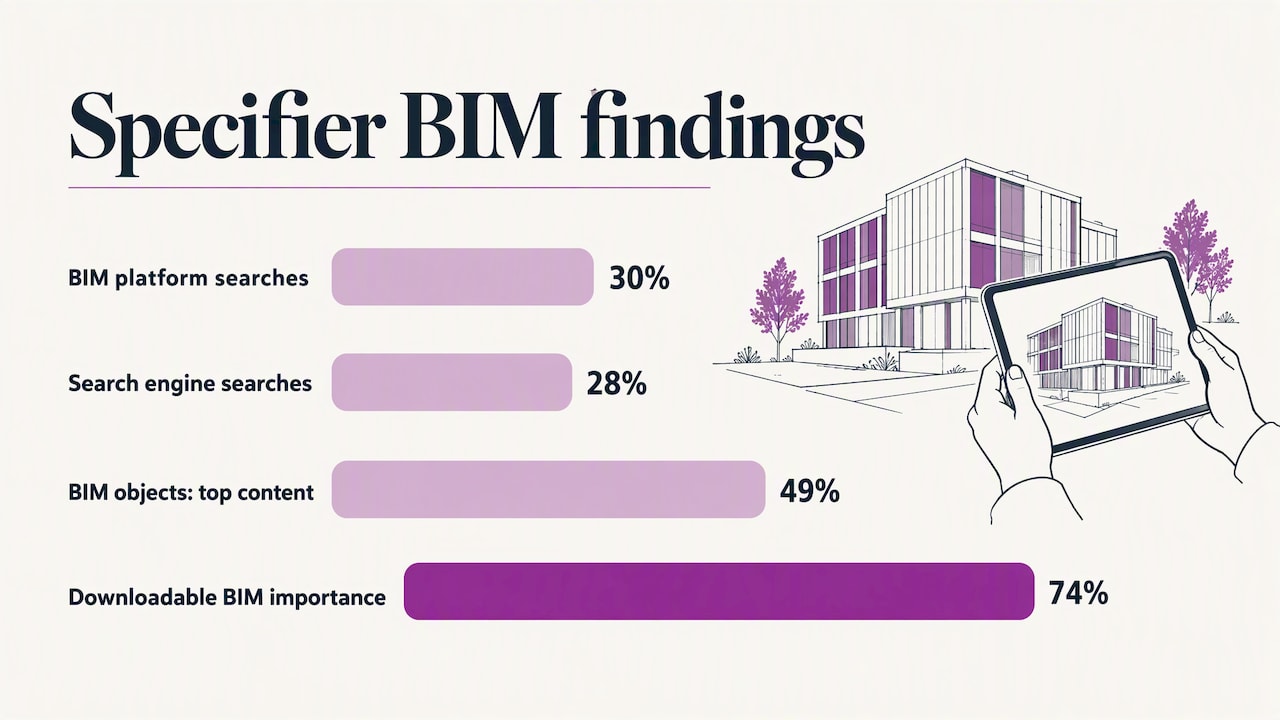
The practical conclusion is simple. If your files are hard to find, you are not in the running. A common and costly mistake is gating BIM files, CSI MasterFormat specifications or code-compliance reports behind lead-capture forms, which pushes specifiers toward competitors that offer frictionless access.
A workable specifier checklist:
- Publish BIM and Revit objects on the platforms specifiers already use, and on your own site.
- Provide guide specifications in the format specifiers paste into project documents.
- Keep test reports and code-compliance documents current and one click away.
- Capture interest through useful follow-ups (project support, sample requests), not by locking the files.
- Version everything, so a specifier never downloads an outdated file.
That last point is where a central asset system earns its keep. When one approved version of every file lives in one place, with your digital asset manager feeding it, the field stops circulating old PDFs.
Understand the distribution you depend on
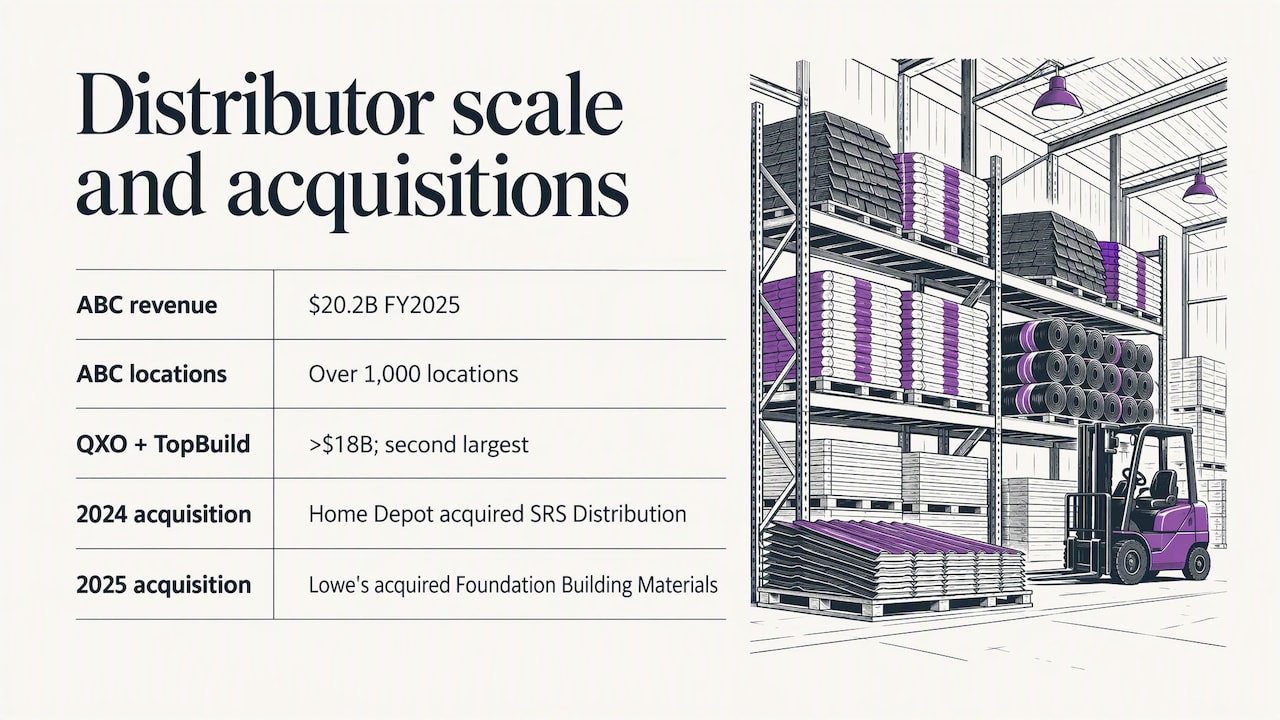
Your distributors are getting bigger and fewer. According to Modern Distribution Management, ABC Supply remains the largest wholesale distributor of roofing and select exterior products in North America at $20.2 billion in FY2025 revenue and over 1,000 locations. The combined QXO and TopBuild entity is positioned as the second largest at more than $18 billion. Recent deals include Home Depot acquiring SRS Distribution in 2024 and Lowe’s acquiring Foundation Building Materials in 2025.
Two things follow for marketers.
Fewer, larger partners means each relationship carries more weight. A national distributor with hundreds of branches will not run bespoke programs for every manufacturer. The easier you make your program (pre-built campaigns, clear fund rules, simple claims), the more likely it gets used.
Digital is not the whole story. Despite the push to digitize, much of building materials distribution remains analog: even among the top 20 North American distributors, many lack live public catalogs, and sales still lean on counter transactions and rep quotes. A digital readiness plan has to acknowledge that. Your marketing must equip the counter salesperson and the outside rep as well as the web shopper: printed collateral, line cards, sample kits, and training that arrive on time and on brand.
Share of voice: why smaller brands have to spend smarter
Building products is crowded, and spend matters. Research by John Philip Jones and later econometric studies, summarized in this marketing text, indicates that smaller brands need to spend proportionately more than larger brands to hold or grow share. Larger players can keep their position with a smaller relative increase in share of voice.
If you are not the category leader, you cannot win by matching the leader’s budget line for line. You can win by making each dollar do more work:
- Concentrate on the territories and partner segments where you have a real chance of gaining share.
- Multiply your own spend with partner dollars, through co-op and market development funds.
- Remove waste: duplicate agency work, off-brand local ads, unused fund balances.
The last two are where channel marketing platforms matter most.
Make co-op and MDF funds work for you
Co-op and market development funds are the closest thing manufacturers have to a lever over local marketing. A dealer who spends their own money alongside yours has a stake in the result. But funds only help when partners can use them. Common failure points:
- Partners do not know the funds exist, or cannot find the rules.
- Claims require paper receipts, emails and weeks of waiting.
- Approved ads are hard to find, so partners build their own off-brand versions.
- Corporate cannot see what was spent, where, or what it returned.
A good fund program is easy at both ends. Partners see their balance, pick approved campaigns, and submit proof in a few steps. Corporate sees every dollar, applies rules automatically and reports on return. For a deeper walk through, see our co-op fund management blueprint for building materials brands and our guide to automation and ROI tracking for co-op funds.
The results can be large. SRS Distribution, an IRIS customer, now adds more than $2 million a year in co-op fund use across 70+ vendors. Distributors sit on the other side of the same equation, since they are the ones managing funds from many suppliers, which is why GearBox includes a Reverse Co-op Engagement Tool for them.
Global-to-local: keep the brand intact at the edge
Every building products brand faces the same tension. Corporate wants consistency. Local dealers want to promote their own name, phone number, promotions and projects. Without a system, dealers either wait for corporate or improvise.
Global-to-local marketing solves this by letting corporate lock the elements that must not change (logo, claims, legal copy, product imagery) while letting partners customize what they should (location, offer, contact details, regional language). Approval hierarchies catch anything that needs review, and everything else flows without a ticket. Our page on localized marketing solutions explains how this works, and the same logic applies to scaling promotions with local relevance.
For international programs, language and currency matter. A brand selling in several countries needs translated assets and local pricing in the same workflow, not separate ones.
Perspective: the problem is logistics, not creativity
Most building products manufacturers we meet do not have a creative problem. They have good products, solid brand work and capable teams. What they have is a logistics problem: assets in six places, funds tracked in spreadsheets, vendors managed by email, orders placed by phone, and no single view of what the channel is actually doing.
We have spent more than 20 years working with brands that sell through other people, including Owens Corning, TAMKO, Fiberon, Georgia-Pacific, Schlage and Fortune Brands, and the pattern repeats. The brand that wins is rarely the one with the cleverest campaign. It is the one whose partners can find the right asset in a minute, launch a campaign in an afternoon, claim funds without chasing anyone, and whose marketing team can see all of it.
That is why we built GearBox as a marketing logistics platform rather than another point tool. Campaigns, vendors, co-op dollars, orders and brand assets belong behind one login. Corporate keeps control of the brand and the budget. Local partners get what they need to market and sell. When both sides are served, participation rises, and participation is what turns a program from a plan into revenue.
— Irisnow
Run a practical 90-day plan
You do not need to fix everything at once. A sequence that works for most building products teams:
Days 1 to 30: audit. List every asset type, where it lives, and who uses it. Map your channel partners by tier and by how much they sell. Review fund balances and how much went unused last year. Ask five dealers and two distributors what slows them down.
Days 31 to 60: fix the foundation. Consolidate approved assets in one library. Publish BIM objects, specs and code reports for specifiers without forms. Define which elements partners can customize and which are locked. Write fund rules in plain language.
Days 61 to 90: launch and measure. Roll out a few pre-built campaigns for the top partner tiers. Open fund claims through a single, simple process. Track participation (how many partners launched something), spend, and the sales that followed.
Measure with the 1% rule
Building products sales cycles are long, so waiting for one giant campaign to prove itself is risky. The 1% rule is a mindset rather than a law: make small, measurable improvements to the few activities that drive revenue, such as targeting, landing pages and conversion rate, and repeat. Practitioners run it as a disciplined test-and-learn loop focused on revenue-linked metrics, not vanity numbers.
In a channel program, that might mean testing one change per quarter: a shorter fund claim form, a new default offer in dealer ads, or clearer calls to action on your dealer locator and project pages. Small gains in partner participation compound across every location you have.
Track a short list:
- Partner activation rate: share of partners who ran at least one campaign.
- Fund utilization: claimed dollars as a share of available dollars.
- Time to launch: days from partner request to live campaign.
- Specifier downloads: BIM and spec files per month, by product line.
- Lead and quote volume tied back to campaigns.
Where GearBox fits
GearBox is the marketing logistics platform from IRIS for brands that sell through dealers, distributors, franchisees, agents and advisors. It is modular, so building products teams can start where the pain is worst:
- Asset management, integrating with Adobe DAM and Widen.
- Converge for global-to-local marketing.
- Co-op and MDF fund management, including the Reverse Co-op Engagement Tool for distributors.
- Vendor-agnostic procurement, a B2B marketplace and order tracking.
- Approval hierarchies, payments and sales tax, campaign calendars and analytics.
- Collateral fulfillment for the partners who still need printed materials.
It also supports multilingual and multicurrency programs. Steelcase, for example, runs 15,000+ users across 9 countries on the platform. If you want to see how it would handle your partner network, schedule a demo of GearBox. You can also read how it transforms manufacturing operations.
For related reading, see our guides on channel marketing automation, centralizing marketing operations and marketing for construction company visibility.
FAQ
What is the difference between building products marketing and building materials marketing?
In practice, the terms overlap and readers use them interchangeably. Building materials often suggests raw or commodity goods such as lumber and concrete, while building products includes branded, engineered items such as windows, roofing, decking and insulation. The channel problem is the same for both: you sell through partners, so you market through them too.
Who is the largest building products distributor?
It depends on the segment. Modern Distribution Management reports that ABC Supply is the largest wholesale distributor of roofing and select exterior products in North America, with $20.2 billion in FY2025 revenue. The market is consolidating, so check current figures before you plan around any one partner.
What is the 1% rule in marketing?
It is a mindset of continuous, small, measurable improvements to the activities that drive revenue, rather than betting on one major campaign. You test one change at a time, keep what works and repeat. DigitalFive’s explainer covers how practitioners apply it.
Should specifier content be gated behind a form?
Generally no. Architects and engineers treat BIM files, specifications and code reports as the product itself, and forms push them toward competitors with easier access. Offer the files freely and capture interest through project support, samples or follow-up content.
How do I get dealers to use co-op funds?
Remove friction. Make rules easy to read, show each partner their balance, offer approved campaigns they can launch in a few clicks, and shorten the claim process. Platforms that automate approvals and reporting help, and our co-op fund management page shows how.
Sources
- 2025 BIMobject report on specifier search behavior
- Marketing for Building Materials Manufacturers
- QXO, TopBuild Shareholders Approve $17B Deal, Modern Distribution Management
- Top distributors 2026, Anglera
- Share of voice and share of market research
- 1% Rule in Marketing, DigitalFive
- Importance of CTAs
