


Channel partner incentives are the rewards you offer resellers, distributors, dealers and agents in exchange for the behaviors that grow your revenue. The programs that work reward individual reps and marketing activity, not just company-level activity: SPIFFs for quick activation, MDF and co-op funds for market development, and training incentives for lasting skill. We have run these programs through GearBox®.
Irisnow
Bring Partner Incentives Into One Place
GearBox brings co-op funds, campaigns, orders and brand assets together for brands working with dealers, distributors and other partners.
Table of Contents
Which types of channel partner incentives should you consider?
Think of incentives as a menu. Each type pulls a different lever, and the mistake we see most often is using one lever for every problem. Here is how the main categories break down:
Match the type to the behavior you want. If you need activation next month, reach for a SPIFF. If you want a partner investing in local marketing, use co-op. If you want durable skill, reward certification. For deeper operational guidance on reward models, see our post on how to reward your partners.
How do you design a channel partner incentive program step by step?
A good design starts with behavior, not budget. Work through these steps in order, and resist the urge to launch everywhere at once.
The reason to separate company-level and rep-level rewards is practical. A Partnership Leaders analysis reports that 72% of companies offer commissions as a primary incentive, yet 78% of partners see them as a nice-to-have, and only 27% of those commissions reach the rep who referred the business. A rep-targeted SPIFF cuts through that organizational inertia because the reward lands with the person who did the work.
Pro Tip: Pilot with two or three partner types at once, then compare. A SPIFF that electrifies reps at one partner may do nothing for a distributor who only responds to rebates.
For a longer checklist, our guide to designing a channel partner incentive program walks through program structure and pilot planning.
How should you fund and govern MDF and co-op programs?
Marketing funds fail when they are hard to use or impossible to audit. The goal is a fund partners can actually spend, with controls that let you trace dollars to outcomes.
Start by choosing a funding model. Pre-funded MDF gives partners a set balance up front, which speeds activity and suits mature partners with proven marketing capacity. Claim-based co-op reimburses partners after they spend, which limits your exposure and suits newer or smaller partners. Many brands run both, depending on tier.
Then set the governance rules:
Finally, connect spend to results. Track sourced revenue against fund dollars used, and measure how much of each partner’s available fund they actually spend. Low utilization is usually a usability problem, not a motivation problem. We cover the budgeting side in our channel partner budgeting and incentives guide, and our page on co-op fund management automation and ROI tracking shows how the controls work in practice.
What does it take to run incentives reliably at scale?
A program that works on paper still stalls if partners find it tedious. Delivery is where many incentive programs quietly fail, so plan for the operational load from the start.
The platform features that matter most are:
Onboarding deserves equal attention. Partners adopt a program when the first campaign is easy, which means campaign templates, localized assets and short training ready on day one. Our guide to channel partner relationship management covers onboarding and enablement in more depth.
Integration is the other priority. Connect your digital asset management system, your CRM and your payment systems so partners do not re-enter data and your team does not reconcile it by hand. Keep claims short, make the experience work on a phone, and use vendor-agnostic procurement so partners can order from the suppliers they already trust.
Pro Tip: Time a new partner’s first claim, from start to payout. If it takes more than a few minutes of effort on their side, simplify the form before you spend more on rewards.
Which KPIs show whether your incentives are working?
You cannot improve what you cannot see, and incentive programs are full of vanity numbers. Track a small set of measures tied directly to money and behavior.
Primary KPIs:
Secondary measures include partner satisfaction, certification completion and attach or cross-sell rates. During a pilot, review activation and claim volume weekly, and review ROI and revenue monthly. Set a threshold before launch, for example a minimum incremental margin, so the decision to scale or stop is not a debate.
Build one dashboard that shows these measures by partner type and by incentive, reviewed on a fixed cadence. Our guide to channel marketing KPIs goes deeper on dashboards.
For context on where the industry is headed, the 2024 Partner Program Guide from CRN documents vendor goals such as increased enablement, simpler incentives and new certifications.
Vendors are moving toward simpler incentives and stronger enablement, which matches the measures above: fewer rules, faster payouts and visible skill-building.
What does our practitioner experience show?
We have spent many years running channel programs for brands including SRS Distribution, Steelcase and Applebee’s. SRS Distribution added more than $2 million a year in co-op fund use across 70+ vendors. Steelcase has users across multiple countries. Applebee’s automated menus across many locations.
The pattern across those programs matches what Partnership Leaders found: too many programs reward activity instead of outcomes, and commissions often miss the individual rep. When we simplify rules, make funds easy to claim and tie rewards to results, partners use the program.
What legal and compliance issues come with partner incentives?
Incentives are compensation, so treat them with the same care as any financial arrangement. We are not lawyers, and requirements differ by country and by program, so have counsel review your terms before launch.
Start with the contract. Program terms should state who is eligible, how rewards are earned, when they expire, how disputes are resolved and whether you can change or end the program. Put these in a written agreement partners accept, not in an email.
Next, consider tax. Cash rewards, gift cards and trips may be taxable income to the recipient, and some regions require reporting or withholding. Rebates and MDF can also be treated differently from cash bonuses. Confirm the treatment for each region where you operate.
Be careful with rewards that reach individual employees of a partner. Some partners prohibit their staff from accepting gifts or payments, and anti-bribery and gifting rules can apply, especially with government or regulated customers. Ask partners whether employee-level rewards are allowed.
Finally, protect the data and the money. Keep records of claims, approvals and payouts for audit, and look for operational controls such as those in AICPA SOC reporting frameworks when you evaluate systems that handle funds.
How do you tie incentives into your channel marketing and sales plans?
Incentives work best when they are a tool inside your channel plan, not a separate program living in its own corner. Start from the business goal for the year, such as launching a product, entering a region or growing a certain partner tier, then choose incentives that push that goal.
Align timing across teams. If marketing is launching a campaign in the spring, the SPIFF, the co-op fund release and the training module should open together so partners see one coordinated push, not three competing messages. A shared campaign calendar helps both sales and marketing see what is live.
Connect incentives to the partner journey. New partners get onboarding rewards, active partners get performance incentives and top partners get recognition and early access. This keeps rewards relevant instead of repeating the same offer to everyone.
Share data across teams. Sales sees which partners are on track, marketing sees which campaigns drive the claims, and finance sees spend against budget. When those views match, you can shift dollars toward what works mid-year. For central coordination ideas, see how we approach centralizing marketing operations.
How do you motivate dealers, distributors, franchisees and agents differently?
One offer for every partner type wastes money. Each group has a different business model, and the reward should fit it.
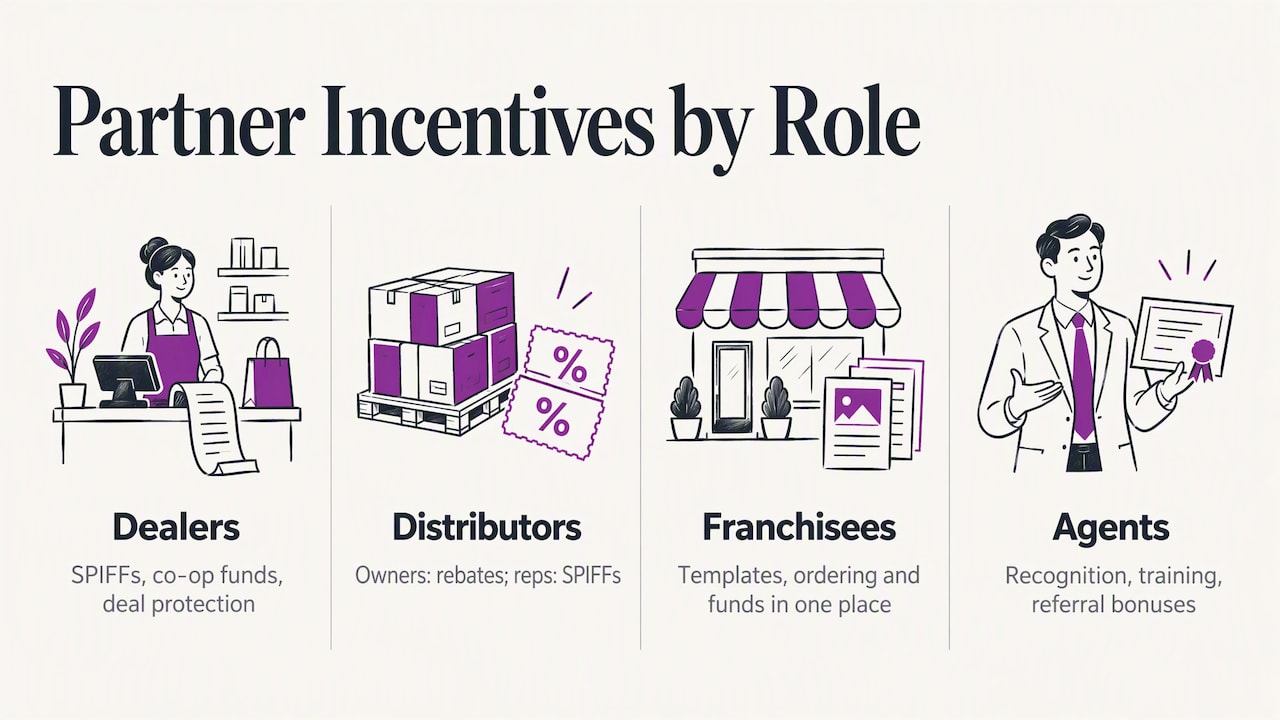
Dealers sell directly to customers and respond well to SPIFFs, local co-op funds and deal protection. They want fast payouts and marketing help they can use right away.
Distributors buy in volume and think in margins. Rebates, volume tiers and funds tied to purchases suit them. Visibility into available funds matters, and so does support for their own sales teams.
Franchisees operate under your brand and need approved, localized marketing. Access to templates, ordering and funds in one place motivates them more than extra cash, because it saves time. Our franchise work shows this pattern in practice.
Agents and advisors often work independently and value recognition, training and referral bonuses. Because they may be one-person operations, the process must be simple and fast.
Within each group, split rewards between the company and the individual where possible. A distributor owner may care about rebates while that distributor’s sales reps care about SPIFFs.
What are the technology challenges of running incentives across regions and currencies?
Global programs add complexity that spreadsheets cannot handle. Plan for these issues early.
Currency and exchange. Partners expect to see balances and payouts in their own currency. Decide whether funds are set in one currency and converted, or budgeted locally, and apply the rate rules consistently.
Language and localization. Rules, forms and training should appear in the partner’s language. Poorly translated terms create disputes.
Tax and payment differences. Payment methods, tax treatment and reporting vary by country, so your system should support local payout options and keep records for each region.
Integration. Connect asset management, CRM, finance and payment tools so data flows once. Disconnected systems produce duplicate entries and reconciliation delays.
Accessibility and access. Partner portals should follow accessibility guidance such as the WCAG 2.0 and 2.1 conformance standards so every partner can use them.
Governance. Set which decisions are made globally and which are local. A global-to-local model, like the one in our localized marketing solutions, keeps brand control while letting regions act.
Where should you start when you redesign incentives?
Start small and short. Run a pilot of a few weeks tied to one revenue behavior, measure it, and expand only what works. Teams that skip this step end up with a complicated program nobody understands.
Invest in making rewards easy to get. A simple claim and a fast payout will do more than a bigger bonus buried behind paperwork. Enablement belongs in the same bucket: partners who understand the product and can launch a campaign in minutes will use your incentives.
Lean on automation for approvals and fund tracking. It lets you grow the program without adding headcount, and it keeps the experience consistent for every partner.
Run your incentive and co-op programs from one place
With GearBox®, we centralize co-op and MDF fund tracking, approvals, asset delivery and analytics, so your team spends less time chasing claims and more time growing partner revenue. In a demo, you see how partners and administrators use GearBox® and how spend connects to results. Schedule a demo of GearBox® and see it on your own program.
FAQ
What is a channel partner rewards program?
A channel partner rewards program gives resellers, distributors and other partners points, cash, funds or perks in return for specific actions, such as closing deals, completing training or running campaigns. The best ones tie each reward to a behavior you want to repeat. Our overview of partner reward models explains the common structures.
How do channel partners get paid?
Partners are typically paid through commissions on closed deals, rebates after volume thresholds, referral fees and marketing funds reimbursed or pre-funded for approved campaigns. The mix depends on the partner type and the contract. Payment timing and method should be written into the program terms.
How much do channel partners get paid?
There is no single rate, because payouts vary by industry, product margin, partner type and program design. Set rewards from your own margin and the value of the behavior you want, then test the level in a pilot before rolling it out.
What are examples of channel partners?
Common examples include resellers, distributors, dealers, franchisees, agents, advisors and value-added resellers. Each sells or markets your product through its own business, which is why incentives should fit how each type earns money.