

Field sales enablement is the work of giving in-person sellers the content, tools and training they need to win face-to-face, in places where the office stack often fails them. That means mobile-ready materials, territory-specific content that fits the local buyer, and coaching built on real buyer conversations. It is not a smaller version of inside sales enablement. It is a different job, and it breaks down in different places.
This guide covers what field enablement includes, why most programs stall on admin and findability rather than motivation, how to build the content layer, and what changes when your field sellers are not employees at all but dealers, distributors, franchisees or agents.
Irisnow
Equip Every Channel Partner
GearBox brings campaigns, brand assets, co-op funds and orders together for brands marketing through dealers, distributors and other partners.
TL;DR
Table of Contents
What field sales enablement actually covers
Field sellers meet buyers at job sites, dealer counters, offices, trade events and kitchen tables. One industry glossary frames the practice as mobile-ready tools, territory-specific content and live training for reps working face-to-face, and it contrasts it with inside sales enablement, where the channel is phone, email and video and the tools are web-based.
The contrast matters because it changes how you design everything:
Field sales enablementInside sales enablementWhere the sale happensCustomer sites, regional offices, eventsPhone, email, videoTool designMobile-first, offline-readyWeb-based, cloud-connectedContentTerritory-specific, quick to show on a tabletSequenced for digital outreachTrainingRole-play of high-stakes in-person conversationsCall coaching, email reviewConnectivityNot guaranteedAssumed
A field rep spends 30% to 60% of working weeks in front of buyers, according to one 2026 comparison of sales models. That is a lot of time away from a desk, and it is the time your enablement has to serve.
The term also gets used loosely. Outside sales, door-to-door sales and canvassing all describe roughly the same activity, and that inconsistency causes problems when you start building a team around it. Decide early which kind of field selling you are enabling, because a rep demoing capital equipment needs very different material from a canvasser.
Why field programs stall: structure, not motivation
Leadership often assumes field performance is a motivation issue. The evidence points elsewhere.
SPOTIO’s 2026 State of Field Sales research puts manual admin and data entry at 21% of the work week, roughly eight hours, and about 25% for B2B teams. On a 10-person team, that adds up to thousands of selling hours a year. An analysis of the UK field sales model reports that 62% of paid sales time goes to non-revenue admin. The two figures measure different things in different markets, so do not add them together, but both say the same thing: the gap is built into the workflow.
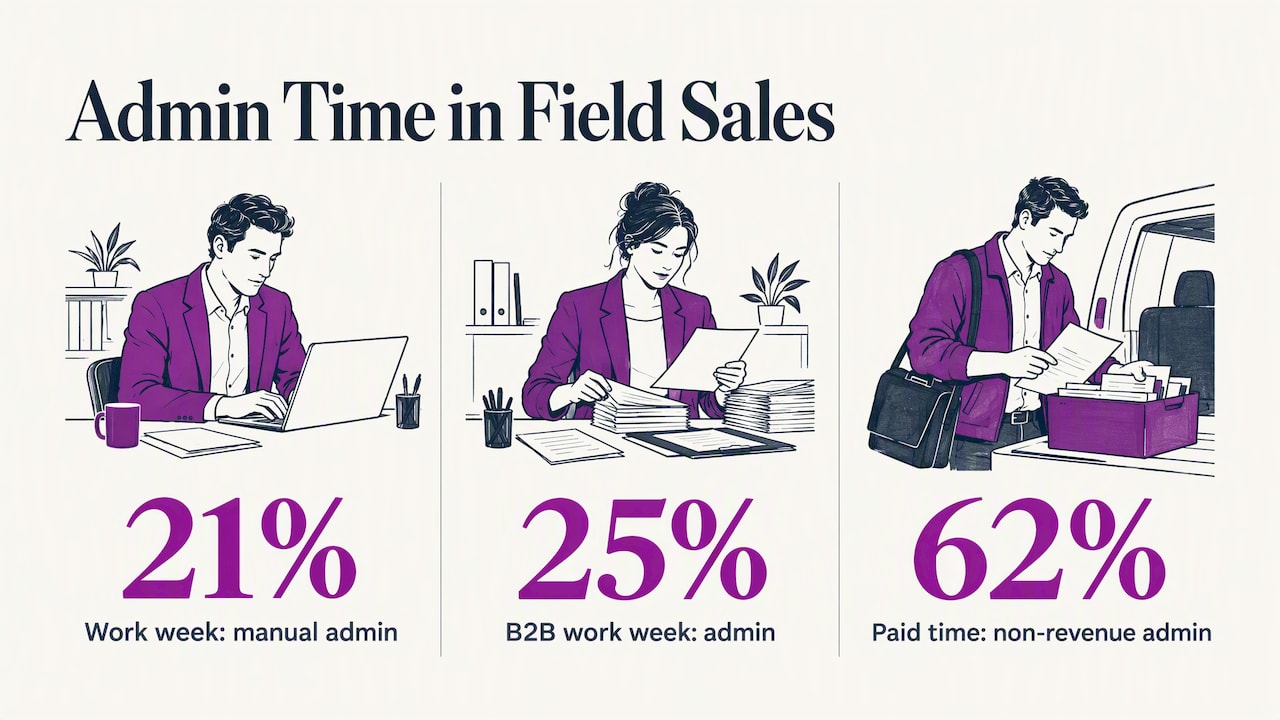
The practical conclusion is uncomfortable. If a rep loses a day a week to forms, hunting for the right deck and re-entering data, another sales kickoff will not fix it. Removing manual steps will.
Adoption is a fit problem
Low tool adoption is often read as laziness. SPOTIO’s mobile CRM research reports a 78% CRM adoption rate among low-turnover field teams versus 54% among high-turnover teams. The difference, according to that research, is that successful teams choose tools that sit inside the rep’s daily workflow instead of acting as a monitoring system. The same source argues that a tool adding even 30 minutes of daily friction will likely be bypassed.
That gives you a clean test for any enablement tool you plan to roll out: does it remove work the rep already does, or add a new chore for the benefit of head office?
Test the dead zones
A pitfall that only shows up in the field: apps that work in the office and fail in basements, rural areas and conference halls. The same workflow guide recommends field-grade platforms with downloadable territory data that works for at least 24 hours without Wi-Fi and syncs automatically when the signal returns. Before you buy or build anything, hand it to a rep, switch on airplane mode and ask them to run a real meeting.
Building the content layer
Searchers who ask about sales enablement content usually want to know what to produce. The better question is what to stop producing.
Tie every asset to a deal moment
Content becomes enablement only when it serves a specific moment in a deal. Edithly’s guide to enablement content warns against producing large volumes of collateral that reps never open, and suggests auditing the library every two quarters, archiving unused items so reps can find what they need in seconds.
For field sellers, a useful way to map this is by moment rather than by asset type:
If an asset does not belong to one of those moments, it is a candidate for the archive.
Make it local without making it chaotic
Field reps sell in markets with their own competitors, promotions, languages and regulations. Corporate material that ignores this gets ignored back. Reps then build their own decks, and brand consistency goes with them.
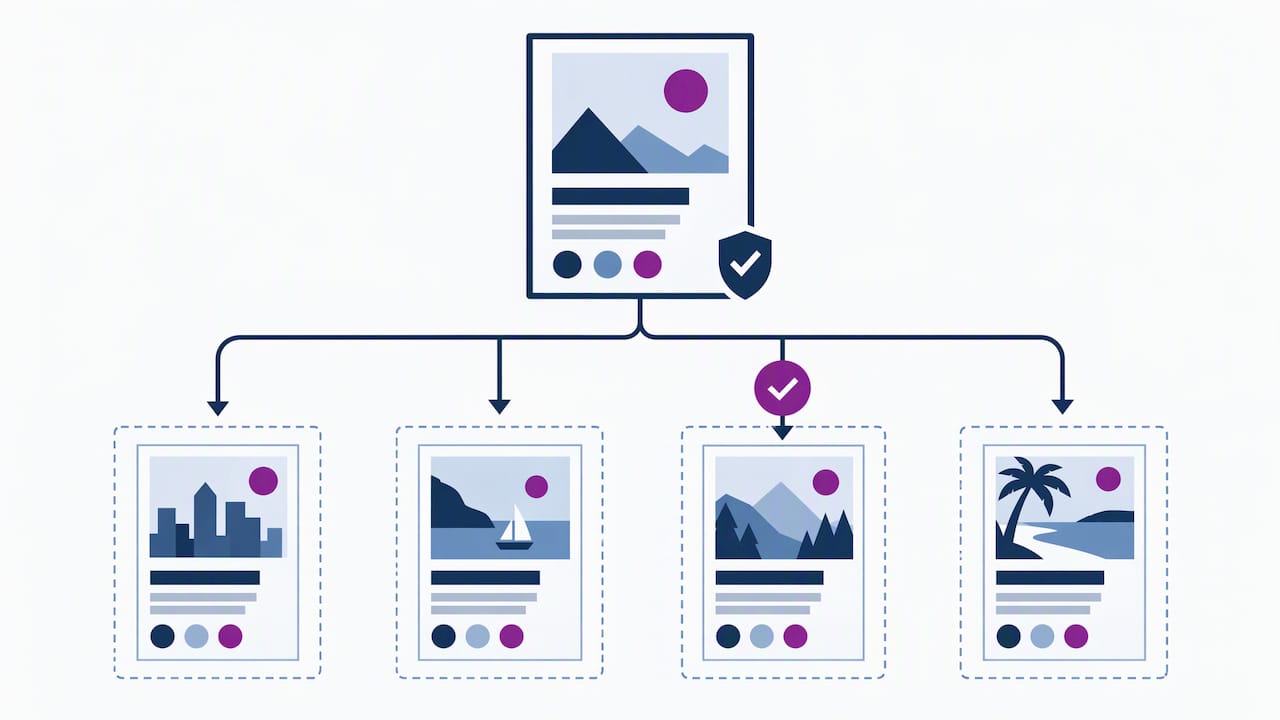
The workable middle is controlled localization: approved templates and assets that a local seller can adapt within set rules, with approvals where they are needed. We describe the approach in our guides to field marketing consistency and global-to-local marketing, and in how brands scale promotions with local relevance.
Keep the library findable
A bloated folder is a tax on every meeting. Three habits keep it lean:
Content automation can help here, especially for high-volume variations, and we cover how to do it without losing brand control in our piece on content automation marketing.
Staffing and scoping the enablement function
If you are the person being asked to “do enablement,” the temptation is to launch everything at once. Don’t. According to the 2025 Modern Enablement Benchmarks Report (SBI and RES), enablement teams in mature organizations have moved past being a content repository and typically manage seven or more activities, including onboarding, training and program measurement. Practitioners quoted in the research warn that trying to do everything at once is a failure point, and suggest staffing the fundamentals of onboarding, content curation and training first.
On pay, which many readers also look up: Prospeo’s role breakdown puts median enablement pay at $125,000 globally, with “revenue enablement” titles averaging $163.9K. Treat those as one source’s 2026 estimates. They are useful for budgeting a hire, but pay varies by company size and region.
For context on the sellers themselves, Prospeo’s field rep profile lists entry-level field reps averaging around $48K in total compensation. High turnover is costly, and the Ell Advisory analysis cited above estimates replacement cost per UK rep at £82k to £110k. Whatever the exact number in your market, losing a rep because the tools got in the way is expensive.
Our perspective: when your field sellers are partners
Most field sales enablement advice assumes the seller is on your payroll. Plenty of brands sell through dealers, distributors, franchisees, agents and advisors instead. For them the field team is somebody else’s employee, and the enablement problem looks different.
We have spent more than 20 years working with brands that sell this way, including Applebee’s, Steelcase, Owens Corning, Honda, Volkswagen, Shell, Schlage, Fortune Brands, Georgia-Pacific, TAMKO, Fiberon and SRS Distribution. Three things stand out from that work.
First, you cannot mandate adoption. A partner can ignore your portal. The only enablement that works is the kind that makes their day easier than doing it alone: ready-to-use campaigns, fast ordering, quick answers on funds.
Second, content is only half of it. A partner who has an approved flyer but no clear way to use co-op dollars, find a vendor or place an order will still improvise. Assets, vendors, funds, approvals and orders belong behind one login, so corporate keeps control of the brand and the budget while the local partner gets what they need to market and sell.
Third, the admin tax multiplies. If one rep loses a fifth of the week to paperwork, a network of hundreds of dealers loses it many times over, and most of it never shows up in your reporting. We built GearBox® to take that work out of the partner’s hands.
The results we point to are operational. SRS Distribution added more than $2 million a year in co-op fund use across 70+ vendors. Steelcase runs 15,000+ users across 9 countries. Applebee’s automated menus across nearly 2,000 locations.
How to run a field enablement program: a practical sequence
For partner networks, our guide to channel partner management covers onboarding and motivation in more depth, and this piece on cross-departmental integration deals with the sales, marketing and operations alignment that field enablement depends on.
A note on the changing buyer
Field sales is not going away, but it is changing. Apollo’s outside sales guide cites a Gartner 2025 survey finding that 61% of B2B buyers prefer a rep-free buying experience overall. The implication for enablement is that when a buyer does agree to meet in person, the meeting has to count. Reps arrive already informed, so material that repeats a website adds nothing. Field content should help with the things a buyer cannot do alone: see the product in context, compare options live, settle terms and decide.
Academic work on the subject points the same way. A 2022 case study of sales enablement in complex B2B companies describes enablement as aligning resources across functions and hierarchy levels to support salespeople. In other words, it is cross-functional by nature, which is why a content team working alone rarely moves the result.
Where GearBox® fits
If your field sellers are dealers, distributors, franchisees, agents or advisors, GearBox® gives them one place for campaigns, assets, vendors, co-op and MDF funds, orders and approvals. It integrates with Adobe DAM and Widen for asset management, supports multilingual and multicurrency programs, and lets corporate keep control of brand and budget. Many teams start with centralizing marketing operations or with co-op fund management, then add modules. You can see how it plays out in our Applebee’s case study. When you’re ready to see it against your own network, schedule a demo.
FAQ
What is field sales enablement?
It is the set of cross-functional efforts that support sellers working in person, outside a controlled office. It centers on mobile-ready tools, offline functionality, territory-specific content and training that mirrors real buyer conversations. It draws on sales, marketing and operations together.
How is field sales enablement different from inside sales enablement?
Inside enablement focuses on digital channels such as phone, email and video, with cloud-connected tools. Field enablement has to work in the buyer’s space, often without reliable connectivity, and relies on local content and in-person role-play. The tools and the coaching both change.
What should sales enablement content include for field reps?
Only material tied to a specific moment in the deal: pre-visit account and territory information, a short demo path, comparison and pricing sheets for the close, and follow-up assets. Audit the library every two quarters and archive anything reps do not use.
How do you enable dealers or distributors who are not your employees?
Make your program easier than the alternative. Give them approved, adaptable campaigns, a clear route to co-op funds and vendors, and simple ordering, all in one login. Because you cannot mandate use, adoption depends on removing their admin work rather than adding yours.