


Marketing logistics is the planning, implementing and controlling of the flow of materials and finished goods from where they originate to where they are used, so that customer requirements are met at a profit. That is the textbook meaning, and it still holds. But for brands that sell through dealers, distributors, franchisees or agents, the phrase has a second, very practical meaning: getting the right campaign, the right asset, the right funds and the right printed piece to the right local partner at the right moment. This guide covers both, and shows how to build a strategy around them.
TL;DR
- Marketing logistics is the physical and informational flow that gets products, and the marketing that sells them, to the customer at the right place and time, at a profit.
- It sits inside marketing, not beside it: marketing creates demand, logistics services it.
- The core activities are transportation, warehousing and inventory management. For channel brands, add campaign materials, co-op funds, vendors and approvals.
- A workable strategy aligns corporate goals, customers, suppliers and the pipeline, then tracks a short list of service and cost measures.
- Brands with many local sellers usually outgrow spreadsheets and email. A single platform for campaigns, vendors, funds and orders is the usual next step.
Table of Contents
- What marketing logistics means
- Marketing logistics vs. the marketing supply chain
- The core activities of marketing logistics
- The version channel brands live with every day
- Marketing logistics examples
- How to build a marketing logistics strategy
- How to measure it
- Our perspective
- Where GearBox fits
- What to look for in a marketing logistics platform
- FAQ
- Sources
What marketing logistics means
The standard academic definition describes marketing logistics as planning, implementing and controlling the physical flow of materials and finished goods from the point of origin to the point of use, in order to meet customer requirements at a profit. Three words in that sentence do the work: flow, requirements and profit.
Flow means the movement is continuous and coordinated, not a series of separate handoffs. Requirements means the customer sets the standard: the right product, in the right condition, in the right place, on time. Profit means service is never free. Every faster delivery or extra stock location has a cost, and the job is to find the point where service and cost make sense together.
One shift in thinking matters here. Traditional physical distribution started with the product at the plant and looked for cheap ways to push it out. Modern marketers, as one marketing principles text frames it, start with the marketplace and work backward to the factory. The customer’s need pulls the system, rather than the factory pushing into it.
Is logistics part of marketing?
Many companies treat logistics as an independent function that lives in operations. A 2022 paper by Omer Baybars Tek argues that this is a mistake: logistics is an essential sub-mix of marketing, and treating it separately can lead to costly business errors. His dual model splits marketing into two submixes, obtaining demand (traditional marketing) and servicing demand (logistics).
Earlier work points the same way. Barcik and Jakubiec (2013) describe the two as complementary: marketing stimulates demand, logistics satisfies it. They also note that logistics directly supports place utility, the value added by making a product available in the right location. A brilliant campaign that sends buyers to a shelf, showroom or branch with nothing to sell has failed at logistics, not at marketing, and the customer cannot tell the difference.
Marketing logistics vs. the marketing supply chain
Searchers often use “marketing supply chain” and “marketing supply chain management” as if they meant the same thing. They are close relatives, with a useful distinction.
In Tek’s framing, marketing logistics is the logistics submix at each stage of the value chain, while the supply chain is the total downstream movement of marketing mixes. Put simply:
| Term | What it describes | Typical question it answers |
|---|---|---|
| Marketing logistics | The flow of goods, services and information at one stage or across the system, managed as part of the marketing mix | How do we get the right thing to the customer at an acceptable cost? |
| Marketing supply chain | The whole downstream path, from manufacturer through distributors, dealers or franchisees to the end customer | Who touches the product and the marketing along the way? |
| Marketing supply chain management | The coordination of those parties so demand creation and demand fulfilment work together | How do we keep every partner aligned and supplied? |
Why the two disciplines keep colliding
Researchers have said for decades that these functions need each other. Ellinger (2000) found that marketing and logistics relationships in the companies studied were only moderately effective, and that a shortage of cross-functional collaboration could put superior customer service at risk. His conclusion was that collaborative integration is needed to capitalize on possible service improvements.
The topic is still current. A 2026 book by Fotiadis and colleagues argues that successful organizations manage marketing and supply chain disciplines together to sustain growth. And Noci (2019) observes that in markets shaped by service-dominant logic, marketing strategy has to be able to reconfigure supply chains to reshape value for customers. That takes organizational change, not just new software.
The core activities of marketing logistics
Strip away the theory and marketing logistics is a handful of recurring activities.
Transportation. Moving goods from the manufacturer to the customer, by whatever mode and route balances speed, reliability and cost.
Warehousing. According to OpenStax’s principles of marketing text, warehousing involves receiving and storing new stock, picking and packing ordered items, and shipping them to their next destination. For some products it also means controlling temperature so perishable goods do not spoil.
Inventory management. The same text describes this as deciding the type and quantity of products to hold, so the company avoids having too much or too little stock.
Order processing and information flow. Every physical movement is triggered and tracked by information: orders, approvals, status updates, invoices. When that information lives in inboxes, the physical flow slows down.
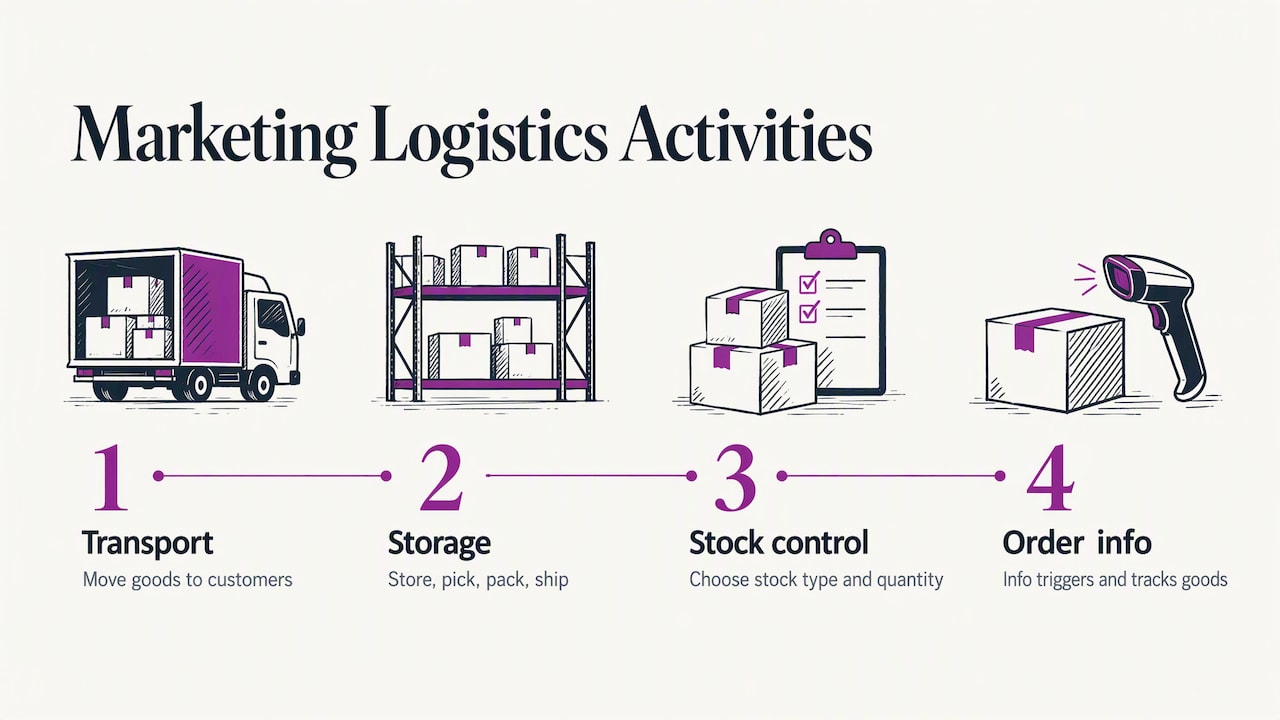
The way these activities connect to channels is the part marketers most often underestimate. If you want a plain-language look at how storage, inventory and transport feed into distribution decisions, these 4Ps of marketing examples show how the “place” decision plays out in practice.
The version channel brands live with every day
The textbook focuses on products. But a brand that sells through other people moves a second stream alongside the product: the marketing itself. Think of everything a local dealer, franchisee or advisor needs in order to market under your name:
- Approved logos, templates and creative, in the right file formats
- Printed collateral, signage and point-of-sale kits, ordered and shipped to hundreds of locations
- Co-op and market development funds, claimed, approved and reimbursed
- Local ads and campaigns that must follow brand rules but reflect local offers
- Vendors (print shops, agencies, media) who need briefs, approvals and payment
This is the marketing supply chain in its most literal form, and it is where the print supply chain question comes from. Each item has a source, a stock position or a budget, an approval path and a destination, exactly like a physical good. The same logic applies: the right thing, in the right place, at the right time, at a profit.
When this goes wrong, the symptoms are familiar. Local partners build their own off-brand materials because the approved ones are hard to find. Co-op dollars go unclaimed because the process is too painful. Corporate cannot see what is running in market. Signage sits in a warehouse while a branch waits on a reorder. For a closer look at the inventory side, see our overview of multi-channel inventory management software and the automated inventory approach for signage and campaign fulfillment.
Marketing logistics examples
A few concrete cases show the range.
A manufacturer shipping product through distributors. The classic case. Transportation, warehousing and inventory decisions determine whether a contractor can get a product on the day they need it. Christopher and Peck’s textbook uses mini-cases to show how managing the supply chain as a whole creates competitive advantage.
A restaurant brand updating menus across locations. Menus are a logistics problem as much as a design one: every location needs the current version, in the right format, by the same date. In our work with Applebee’s, menu production was automated across nearly 2,000 locations. You can read the Applebee’s case study for the details.
A distributor using vendor funds. Distributors that sell many vendors’ products can earn a lot of marketing money, but only if they claim it. With IRIS, SRS Distribution added more than $2 million a year in co-op fund use across 70+ vendors. Our guides to co-op fund management and streamlining co-op fund management for ROI explain the mechanics.
A global manufacturer serving local markets. Steelcase runs on the IRIS platform with 15,000+ users in 9 countries, which means multiple languages, currencies and local approval rules inside one program.
A building products brand supporting contractors and dealers. Funds, assets and campaigns need to reach many small businesses without corporate approving every flyer by hand. Our co-op blueprint for building materials brands walks through that setup.

How to build a marketing logistics strategy
A strategy is not a list of tools. It is a set of decisions about who gets what, how fast, under which controls, and who pays. Jüttner, Christopher and Godsell (2010) describe four levels of strategic integration between marketing and supply chain management: corporate integration, strategic customer integration, strategic supplier integration, and marketing and supply pipeline strategy integration. They make a practical checklist.
1. Corporate level: agree on the goals
Marketing, sales, operations and finance should share one view of what the system is for. Is it speed to market, brand consistency, fund utilization, cost per location? Without one answer, each team optimizes its own corner. Our guide to breaking down silos and cross-departmental integration covers how to get there.
2. Customer level: define the service you promise
For a channel brand, the customers who matter most to the logistics are your partners. Ask what a local dealer needs in order to run a campaign this week, and how long it takes today. Our piece on collaboration in channel marketing and the distributor marketing playbook are good places to start.
3. Supplier level: bring vendors into the system
Printers, fulfillment houses, agencies and media partners are links in the chain. Standard briefs, shared pricing, approvals and payment in one place reduce rework and surprise invoices. See our vendor management guide for channel networks.
4. Pipeline level: connect demand creation to fulfillment
This is the “great divide” the Fotiadis book addresses: demand generation on one side, supply fulfillment on the other. A campaign calendar that shows what is launching, where, and what materials it needs is the simplest bridge. Our article on logistics marketing strategy for distributed brands goes deeper.
A simple order of operations
- Map every asset, fund and vendor flow between corporate and local partners.
- Mark where each one stalls: approval, search, ordering, shipping, payment.
- Set the service standard you want (for example, how quickly a partner should get an approved, localized asset).
- Centralize the system of record, then let local partners self-serve within brand and budget rules.
- Review results on a regular rhythm and adjust.
How to measure it
The academic definition gives the frame: service to the customer at a profit. Measure both halves.
- Service: time from request to delivery of an asset or order, share of orders fulfilled correctly, partner adoption of approved materials.
- Cost: cost per order or per location, spend with each vendor, waste from obsolete printed stock.
- Funds: share of available co-op or MDF dollars actually used, and the time from claim to reimbursement.
- Control: share of local marketing that goes through approval and meets brand standards.
- Outcome: sales and lead activity tied to campaigns, by partner and region.
Pick a baseline before you change anything. Most programs find the first gains in fund utilization and cycle time, because those are the areas where manual work is heaviest.
Our perspective
Marketing logistics is usually taught as trucks and warehouses. For the brands we work with, the harder problem is that marketing itself has to travel through hundreds or thousands of independent hands. Corporate wants control of the brand and the budget. Local partners want speed and freedom to sell. Both are right, and a shared mailbox cannot serve them both.
After more than 20 years of building for this, our view is simple. Put every campaign, vendor, co-op dollar, order and brand asset behind one login. Let corporate set the rules once. Let each partner get what they need without asking. When the system makes the compliant path the easy path, the brand stays consistent without anyone policing it.
We also think marketing logistics deserves a seat in the marketing plan, not a line in the operations budget. The campaign is not finished when the creative is approved. It is finished when the right partner has the right materials and funds in market.
— Client
Where GearBox fits
If your brand sells through dealers, distributors, franchisees, agents or advisors, GearBox® is the marketing logistics platform we built for that job. It is modular, so you can start with the problem that hurts most and add from there: asset management (with Adobe DAM and Widen integration), Converge® for global-to-local marketing, co-op and MDF fund management, vendor-agnostic procurement, a B2B marketplace, order tracking, approval hierarchies, payments and sales tax, campaign calendars, analytics and collateral fulfillment. It supports multilingual and multicurrency programs. To see it against your own workflow, schedule a demo through the GearBox page.
What to look for in a marketing logistics platform
If you are comparing options, judge them by type and by fit, not by feature count. The categories you will meet include generic project management tools, standalone asset libraries, print procurement portals, fund-claim software and integrated channel marketing platforms. Each solves one slice. The question is whether you want to stitch slices together or run one system.
Use these criteria:
- Scope. Does it cover assets, campaigns, funds, vendors and orders, or only one?
- Control and freedom together. Can corporate set approval hierarchies and brand rules while partners self-serve?
- Integration. Does it work with the asset management tools you already use?
- Vendor flexibility. Can you keep your preferred printers and agencies?
- Global reach. Does it handle several languages, currencies and sales tax rules?
- Visibility. Can leadership see spend, fund use and campaign activity in real time?
- Fit with your industry. Manufacturing, building products, franchise, real estate, insurance and finance each have their own rules and funding models. See how this works in manufacturing, or in our guides on centralizing marketing operations and multi-office real estate marketing.
If your business is itself a logistics or transport company that needs to market its services, that is a different problem. Our article on marketing in the logistics industry covers it.
FAQ
What is marketing logistics?
It is the planning, implementing and controlling of the flow of materials and finished goods from origin to point of use, so customer requirements are met at a profit. In practice it covers transportation, warehousing, inventory and the information that drives them. For channel brands it also covers the flow of campaigns, assets and funds to local partners.
What is the difference between logistics and marketing?
Marketing obtains demand and logistics services it, as Tek’s dual model puts it. They are separate activities but one system: demand with no fulfillment disappoints customers, and fulfillment with no demand wastes capacity. Best results come when the two teams plan together.
How does marketing logistics relate to the marketing supply chain?
Marketing logistics is the logistics element at each stage, while the marketing supply chain is the whole downstream movement of marketing mixes from the brand to the customer. Managing that chain means coordinating every partner along it. For channel brands, those partners are distributors, dealers, franchisees and the vendors who support them.
What are the main goals of marketing logistics?
The goals are to meet customer requirements, add place utility by making products available where customers need them, and do it at a profit. In a channel program, that translates to faster partner access to approved materials, higher use of available funds and tighter brand control.
How do I get started?
Map what moves between corporate and local partners, find where it stalls, and set a service standard. Then centralize the system of record so partners can self-serve within your rules. If you would like to see what that looks like in one platform, schedule a GearBox demo.
Sources
- Chapter 9 – Distribution, Marketing Principles (VCU Libraries)
- Marketing Function and Logistics Revisited: Revised Dual Sub-Functional Model (Tek, 2022)
- Marketing Logistics (Barcik and Jakubiec, 2013)
- Improving Marketing/Logistics Cross-Functional Collaboration (Ellinger, 2000)
- Integrating Marketing and Supply Chain Management (Fotiadis et al., 2026)
- The evolving nature of the marketing–supply chain relationship (Noci, 2019)
- A strategic framework for integrating marketing and supply chain strategies (Jüttner et al., 2010)
- 17.6 Logistics and Its Functions, Principles of Marketing (OpenStax)
- Marketing Logistics, 2nd Edition (Christopher and Peck)
- 4Ps of marketing examples
