


Marketing procurement is the discipline of sourcing, contracting and managing the suppliers behind your marketing: agencies, media, production, events, research and digital services. Done well, it controls spend and raises the value you get from every supplier. Done badly, it becomes a gate that slows campaigns down. This guide covers what the function includes, the process step by step, the practices that hold up, and the part most guides skip: what changes when your brand sells through dealers, distributors, franchisees or agents.
TL;DR
- Marketing procurement covers the sourcing, contracting and supplier management of marketing services. It is a form of indirect spend, so it needs its own category expertise.
- A workable process has five steps: define needs, scan the market, run selection, negotiate, then contract and manage performance.
- The best results come from marketing and procurement working together from the start. Marketing owns strategy and creative choices, and procurement owns commercial rigor.
- Judge suppliers on strategic thinking, creative quality, team fit and execution, not price alone.
- If you sell through partners, procurement has a second job: giving local marketers approved vendors, funds and assets without losing control of the brand or the budget.
Table of Contents
- What marketing procurement covers
- The marketing procurement process in five steps
- Best practices that hold up
- Common challenges and how to fix them
- When your marketing runs through dealers, distributors and franchisees
- Our perspective: procurement is how the brand reaches the local level
- Putting it into practice: a 90-day starting plan
- Where GearBox® fits
- FAQ
- Sources
What marketing procurement covers
Marketing procurement manages the sourcing, contracting and supplier relationships for marketing-related services. Typical categories include advertising, media buying, creative agencies, digital services, market research and events. The goal is control of spend and supplier value, not just a lower invoice.
The scope depends on the company. A WFA report on global marketing procurement notes that the category has 20+ sub-categories, and that new ones keep appearing, including digital commerce, digital shopper experience, virtual events and live streaming. The same report observes that a smaller organization may have one marketing category manager covering all spend, while a larger one may employ dedicated specialists per sub-category.
Marketing spend is also regarded as indirect spend: goods and services not directly tied to manufacturing a product or running a core business process. That matters because indirect categories rarely have the clean specifications of, say, steel or packaging. A creative agency’s output is hard to specify in advance, which is why a pure price-per-unit approach often fails.
How it differs from standard procurement
Buying a commodity is mostly about specification and price. Buying marketing is about judgment: is the idea good, does the team fit ours, can they execute at the scale we need? The same sourcing steps apply, but the evaluation criteria shift toward capability, quality and fit. Marketing procurement also aims at brand performance, campaign effectiveness, innovation and marketing value, not only savings. For a broader look at what a marketing offering can include, see this overview of brand marketing for specialized manufacturers, which shows how many distinct services a single brand may need to buy.
The marketing procurement process in five steps
The process below follows the five-step model commonly used for this category. Treat it as a frame, and adapt the weight of each step to the size of the spend.

1. Identify marketing needs
Start with the business objective, not the supplier. What does marketing need to achieve this year, in which channels and markets, and with what budget? Procurement and marketing should agree on requirements together. In the example McKinsey describes, procurement worked with marketing to define agency requirements before going to market.
A useful brief at this stage answers four things: the outcome you want, the volume and geography of work, the skills required, and how you will measure success.
2. Analyze the market and identify suppliers
This is market research and supplier discovery: identifying and gathering information on potential agencies, vendors or other sources before inviting them to compete. Procurement brings benchmarks and market intelligence. Marketing brings knowledge of who does outstanding work. Look at your current roster too. Consolidating overlapping suppliers is often the first quick win.
3. Run the sourcing or agency selection process
Depending on spend and risk, this ranges from a quick quote comparison to a multistage pitch. McKinsey’s example invited agencies to a multistage pitch rather than a single price-driven round. Match the formality to the stakes: a six-figure agency-of-record decision deserves a full RFP, while a one-off print job does not.
4. Evaluate proposals and negotiate terms
Supplier evaluation should weigh strategic thinking, creative quality, team fit and execution capability, not just price. That is the point where many programs go wrong. If you want a sharper view of scoring proposals without letting the lowest bid win by default, this piece on evaluating agency proposals is worth a look as you build your criteria.
In the McKinsey example, preferred agencies were selected and the terms were then negotiated jointly by procurement and marketing. Joint negotiation keeps commercial terms aligned with the creative relationship you actually want.
5. Contract, implement and manage performance
Signing is the midpoint, not the finish. Set scorecards, review cadence and escalation paths in the contract. Then track performance against them. Without this step, the savings negotiated in step four tend to leak away through scope creep and off-contract buying.
Best practices that hold up
The research and practitioner literature converge on a short list.
Collaborate throughout, not at the end. McKinsey’s guidance is close collaboration throughout the purchasing process: procurement analyzes spend and the supplier market, marketing assesses agency capabilities and cultural fit, and procurement leads the tough conversations when performance slips.
Keep strategy with marketing. Strategic decisions such as agency selection and campaign design should remain with marketing, while procurement supports supplier management and commercial negotiation. Procurement that overrules creative judgment creates the very friction it was meant to remove.
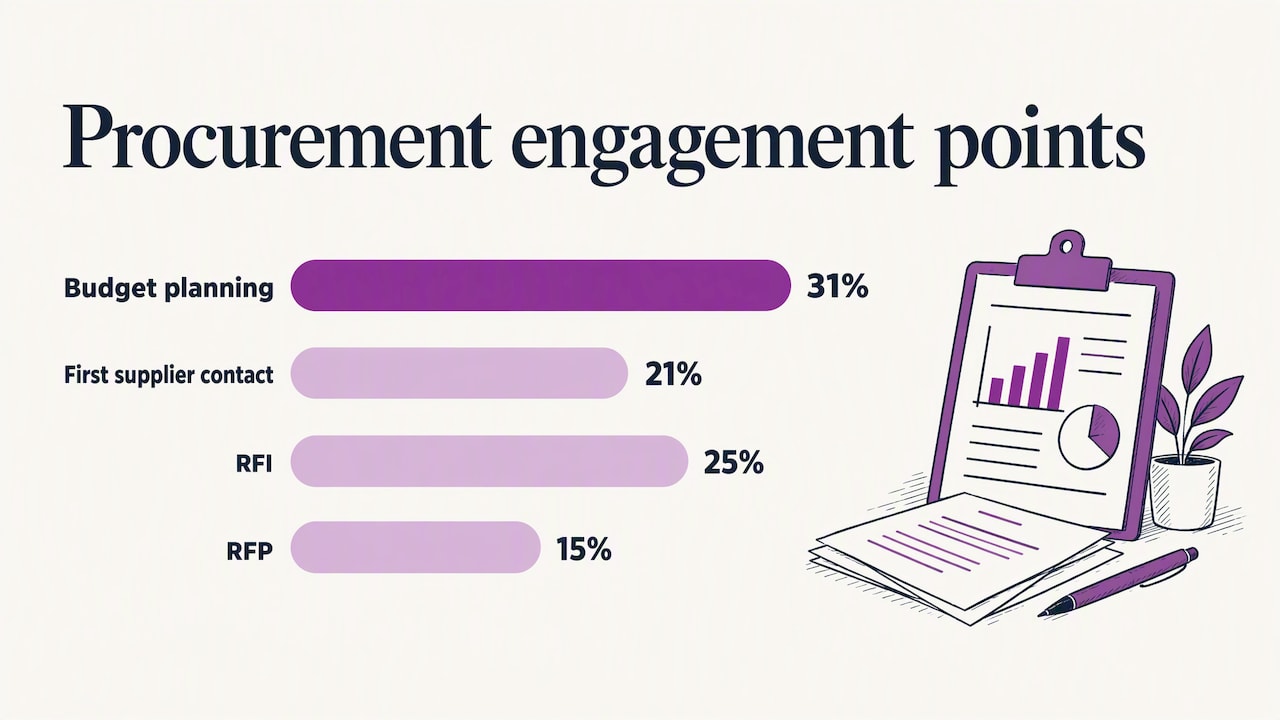
Get involved early. A WFA survey from the third quarter of 2018 found procurement engaged at different points: 31% at budget planning, 21% at first supplier contact, 25% at RFI and 15% at RFP. The later procurement arrives, the fewer levers it has. The data is dated, but the direction of the advice has not changed.
Use flexible rules. Rigid policies push marketers to work around procurement. McKinsey recommends flexible rules that allow responsiveness while controlling risk. A preferred-vendor list with fast approval for small jobs, and full process only above a threshold, is a common shape.
Measure outcomes, not only savings. Teams can use marketing-ROI data and balanced scorecards to track the efficiency of agency and media purchasing and the effectiveness of the resulting placements. A scorecard might pair a cost measure (rate against benchmark) with a performance measure (campaign results) and a relationship measure (responsiveness, quality of team).
Connect to the business. The WFA argues that procurement should partner with marketing and finance to tie workstreams to business outcomes and align commercial strategies with objectives. The same report notes growing pressure around sustainability and diversity and inclusion, so expect supplier criteria on both to become standard.
Common challenges and how to fix them
McKinsey names the recurring problems: tension between marketing and procurement, late involvement, procurement seen as a barrier, and difficulty understanding each other’s aims. Its remedy is closer collaboration throughout purchasing and a shared understanding of goals.
In practice, here is how that translates:
| Challenge | What it looks like | What helps |
|---|---|---|
| Late involvement | Procurement sees a signed statement of work | Bring procurement in at budget planning |
| Seen as a barrier | Marketers buy off-contract to move fast | Fast lanes for small spend, clear thresholds |
| Different goals | Savings versus creative quality | Shared scorecard with both cost and performance |
| Poor visibility | Spend sits in many local budgets | One system of record for orders and approvals |
The last row is where the standard advice runs out, and where brands that sell through partners feel the most pain.
When your marketing runs through dealers, distributors and franchisees
Most marketing procurement guidance assumes one central marketing team buying for one company. If you sell through other people, the picture is different. Spend is split between corporate and hundreds or thousands of local partners. Co-op and market development funds pay for local activity. Local marketers need print, signage, digital ads and assets today, and they will buy them from whoever is quickest if you do not give them a better option.
That creates three procurement problems:
- Vendor sprawl. Every dealer finds its own printer, sign shop or agency, and brand standards drift.
- Fund leakage. Co-op dollars go unused because claiming them is slow, or are spent on off-brand work.
- No visibility. Corporate cannot see what was ordered, from whom, at what price, or whether it worked.
The fix is to treat the partner network as an internal customer of procurement. Give partners a catalog of approved vendors and products, templates they can localize inside brand rules, and a clear path to use their funds. Corporate keeps the approval hierarchy, pricing agreements and reporting. Our guides on procurement management for marketing logistics and vendor management for channel networks go deeper on structuring this, and the article on print procurement at scale covers the highest-volume category for most channel programs.
What vendors and partners need
From the partner side, “seamless” comes down to a few things: one place to log in, pre-approved vendors so nobody has to run a sourcing event for a banner, assets that are already on brand, and fast approvals. From the vendor side, it is clear specifications, consistent order data and predictable payment. When both sides work from the same system, procurement stops being a bottleneck and becomes the service that makes the right choice the easy choice.
Our perspective: procurement is how the brand reaches the local level
We have spent more than 20 years building marketing logistics for brands that sell and market through other people, and our view is simple. Procurement policy that lives in a PDF does not govern what happens in a dealer’s office. Policy works when it is built into the place where partners actually order, claim funds and pull assets.
Three things follow from the work we have done with brands in manufacturing, building products, franchise and restaurants, real estate, insurance and finance:
- Unused funds are a procurement failure. When SRS Distribution moved onto GearBox, it added more than $2 million a year in co-op fund use across 70+ vendors. The money existed already. The process had been the barrier.
- Scale needs one front door. Steelcase runs 15,000+ users across 9 countries on a single platform, with local teams working inside corporate guardrails.
- Control and speed are not opposites. Applebee’s automates menus across nearly 2,000 locations, which is only possible because approvals and brand assets sit in one governed system.
If your procurement team is asking how to keep control of the brand and the budget while local partners keep moving, that is the problem we built GearBox® to solve.
— Client
Putting it into practice: a 90-day starting plan
You do not need a full transformation to improve. A sequence that works for many teams:
- Days 1 to 30: map spend. List every marketing category, supplier and budget owner, including local and co-op spend. Mark which categories are centrally bought and which are bought locally.
- Days 31 to 60: set rules and thresholds. Decide which categories get a formal sourcing event, which get a preferred-vendor list, and which stay flexible. Write one shared scorecard that marketing and procurement both sign.
- Days 61 to 90: launch the front door. Put approved vendors, templates and ordering in one place, and bring the first group of partners onto it. Start measuring fund usage, spend under contract and cycle time.
Review the numbers quarterly, and expand category by category rather than all at once.
Where GearBox® fits
GearBox® is our marketing logistics platform. It puts campaigns, vendors, co-op dollars, orders and brand assets behind one login. Procurement can run vendor-agnostic purchasing, approval hierarchies, payments and sales tax, while partners order from a B2B marketplace built around what they need. It is modular, so you can start with the piece that hurts most, such as co-op fund management or asset management, and add more over time. It also supports multilingual and multicurrency programs. If you want to see how it would map to your partner network, you can schedule a demo of GearBox®.
FAQ
What is the difference between marketing procurement and regular procurement?
Regular procurement often buys items that can be fully specified, so price and delivery dominate. Marketing procurement buys services whose quality is subjective, so it weighs strategic thinking, creative quality, team fit and execution alongside cost. It also has to protect brand performance, not only savings.
When should procurement get involved in a marketing project?
As early as budget planning. In the WFA’s 2018 survey, engagement timing was spread from budget planning to RFP, and the earlier stages give procurement more influence over scope, supplier choice and terms. Late involvement is one of the problems McKinsey flags.
Who decides which agency to hire, marketing or procurement?
Both, with different roles. Marketing owns the strategic decision on which agency fits the work, while procurement supports the process, benchmarks, negotiation and ongoing supplier management. Joint evaluation tends to give better outcomes than either team deciding alone.
How does marketing procurement work for brands with dealers or franchisees?
The same principles apply, with an extra layer: partners buy locally and spend co-op funds. The workable approach is a governed catalog of approved vendors and assets, approval rules tied to spend, and shared reporting so corporate sees what was bought and what it returned.
Sources
- Marketing Procurement: Definition, Process + Best Practices
- Global Marketing Procurement: 2020 and beyond (WFA)
- The Marketing Procurement relationship: tips for success (Sievo)
- Maximizing marketing value through smarter procurement (McKinsey)
- Marketing Services procurement guide
- WFA Research Benchmarks the State of Marketing Procurement
- Get more from marketing procurement (WFA)
