



Print procurement is the work of sourcing, buying and managing printed materials, from brochures and signage to direct mail and point-of-sale kits, so that every job meets your quality, budget and deadline standards. For a brand that markets through dealers, distributors or franchisees, it also means deciding who can order what, from which printer, at what price, and with which approved artwork. This guide covers how it works, where it breaks, and how to set it up so corporate keeps control while local partners still move fast.
TL;DR
- Procurement is a managed process (specs, sourcing, contracts, supplier performance). Purchasing is just placing the order. Marketing print needs the former.
- The biggest losses in distributed networks come from off-contract local buying, inconsistent brand execution and invisible spend, not from the unit price of a flyer.
- Standardize your catalog and approval rules before you automate. Automating a messy process only digitizes the mess.
- Judge any platform on vendor flexibility, templates and permissions, co-op fund handling, reporting and how easily local partners will actually use it.
- Executive sponsorship that mandates the program matters more than any feature.
Table of Contents
- What print procurement actually means
- Why print is still worth managing
- Where print procurement breaks in distributed networks
- A practical print procurement process
- Audit before you automate
- What to look for in print procurement software
- Our perspective: print is one part of marketing logistics
- How GearBox® handles print and marketing procurement
- Keeping brand and budget control across channels
- Common mistakes to avoid
- FAQ
- Sources
What print procurement actually means
The CIPS definition of procurement is the buying of goods and services that let an organization run its supply chains profitably and ethically. Applied to print, it covers the whole external print supply chain: market analysis, sourcing, contract negotiation and long-term supplier management. Purchasing, by contrast, is the reactive, transactional act of getting a specific item now.
That difference shows up in daily work. A purchasing mindset says: “We need 5,000 brochures by Friday, who can quote?” A procurement mindset says: “We buy brochures, banners and mailers all year, so we qualify a small set of printers, agree pricing tiers and specs once, and let approved users order within those terms.”
CIPS also describes the “five rights” every purchase should satisfy: the right price (or total cost), quality, time, quantity and place. They are a useful checklist for print because each one fails in a predictable way:
| Right | How it fails in marketing print |
|---|---|
| Price / total cost | Rush fees, reprint costs and shipping to dozens of addresses are ignored in the quote comparison |
| Quality | Colors, stock or logos drift between printers and between locations |
| Time | Local teams wait on corporate approvals, then miss the event or promotion |
| Quantity | Large minimum runs create obsolete inventory; tiny runs cost too much per piece |
| Place | Orders ship to the wrong site, or to corporate first and then get re-shipped |
In the CIPS framework, procurement is either direct (materials that go into production) or indirect (services that support operations, such as marketing, software and utilities). Marketing print is indirect spend. It is often spread across many budget holders, which is exactly why it is so easy to lose track of.
Why print is still worth managing
It is fair to ask whether print is worth the effort. Research firm Smithers reports that offset litho revenues are projected to reach US$310.9 billion globally in 2025, and the same research tracks a steady shift toward digital printing. Print is changing, not disappearing. For brands with physical locations, such as dealers, restaurants, branches and showrooms, signage, menus, brochures and direct mail remain part of how customers make decisions.
That is why the question is rarely “print or digital.” It is “how do we buy and distribute print without waste.” Short runs, print on demand and variable data make it practical to personalize materials for each location, but they also multiply the number of orders, suppliers and approvals you have to govern.
Where print procurement breaks in distributed networks
A single in-house marketing department can run print procurement with a spreadsheet and a few good vendor relationships. The moment you sell through other people, the problems change.
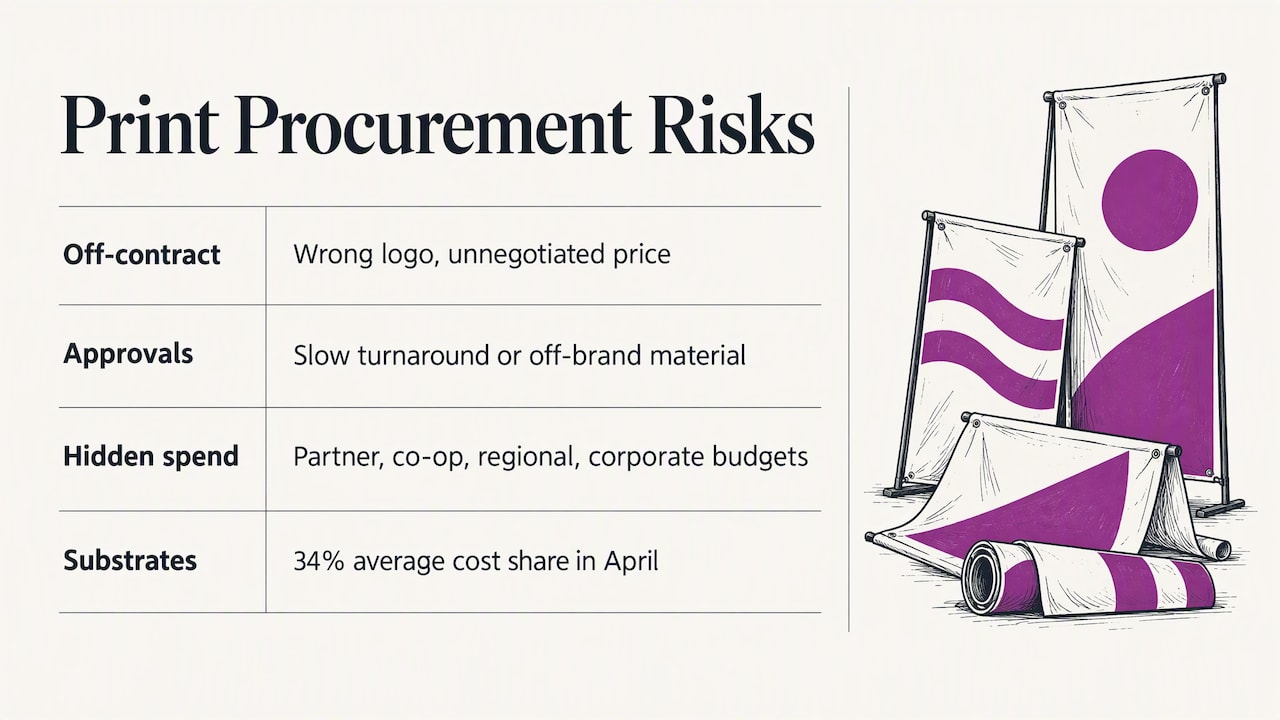
Off-contract buying. A dealer in one region needs banners for a weekend event, so they call a local shop. The banner arrives with the wrong logo lockup and a price you never negotiated. Multiply that across hundreds of partners and you have no negotiating leverage and no brand consistency.
Approval bottlenecks. If every local request goes through one brand manager, turnaround slows and partners stop asking. If nothing is approved, you get off-brand material. Neither extreme works.
Hidden spend. Print paid for by partners, by co-op funds, by regional budgets and by corporate is rarely visible in one place. You cannot reduce what you cannot see.
Cost pressure on suppliers. The BPIF Printing Outlook for Q2 2025 found that paper, board and other substrates were again the largest cost component, at an average 34% share in April, and that printers’ top concern had returned to competitors pricing jobs below cost. For a buyer, that is a warning. A rock-bottom quote from a supplier that cannot sustain it can turn into missed deadlines and uneven quality. Look at supplier stability, not only the lowest number.
A practical print procurement process
Here is a sequence that works for brands with a distributed channel.
1. Map what you buy today
Pull a year of print spend from accounts payable, partner reimbursements and co-op claims. Group it by item type (collateral, signage, direct mail, promotional products), by supplier and by who ordered. Expect surprises: duplicate suppliers, one-off items that are really recurring, and partner-paid spend nobody tracked.
2. Standardize specifications
For each recurring item, write down size, stock, finish, color standards, quantity tiers and packaging. A clear spec is what lets you compare quotes fairly. Guidance on running a quote process, such as this step-by-step RFQ overview, stresses documenting exact specifications, quantities and delivery timelines so that every supplier quotes the same thing, and scoring bids on delivery speed and quality compliance as well as price.
3. Source and qualify a supplier set
Most networks do better with a handful of qualified printers than with hundreds of local shops. Choose by capability (litho, digital, large format, mailing, fulfillment), geographic coverage, capacity at peak times and financial stability. Negotiate framework agreements with price tiers so every approved user buys at the contracted rate.
Sustainability criteria belong here, not after the fact. A German public-sector checklist for print media and promotional items is a good example of how detailed this can get, covering paper, inks and the printing process itself. If your customers or investors ask for environmental reporting, ask suppliers for the data up front.
4. Build templates, catalogs and permissions
This is the step that makes distributed buying work. Locked brand elements, editable fields (name, address, phone, offer) and pre-approved items let local partners create what they need without a designer. Permissions decide who sees which catalog, who can order, and who needs approval above a given amount.
Our own view is that customizable collateral is the lever that gets partners to use the program at all. We cover it in more depth in our piece on customizable marketing collateral for channel partners.
5. Route approvals by risk
Not every order needs the same scrutiny. A reorder of an approved brochure should flow straight through. A new design, a regulated claim or a large budget deserves review. Approval hierarchies that match risk keep speed high where it is safe and control tight where it matters.
6. Connect funding
If partners use co-op or market development funds to pay for print, ordering and fund tracking should live together. When a partner places an order, the system should know which fund pays, how much remains and whether the item qualifies. Our guide to co-op fund management strategies for automation and ROI tracking explains how that works.
7. Measure and review suppliers
Track on-time delivery, reprint rate, cost per piece against contract, spend by category and by region, and the share of orders placed on contract. Review suppliers quarterly and use the data in renewals.
Audit before you automate
Practitioners who have moved from manual to platform-based print buying repeatedly report the same trap. Migrating an uncatalogued pile of old files and legacy items into a new system, as one print procurement software roundup puts it in effect, digitizes the chaos. Vendor onboarding and catalog standardization take more effort than most teams expect.
A few rules of thumb follow:
- Retire obsolete items and consolidate near-duplicates before launch.
- Redesign your approval hierarchy instead of copying the old one. A slow approval path automated is still a slow approval path.
- Get an executive sponsor to mandate use. The same source points to leadership backing as the main difference between programs that stick and ones that stall, because regional offices otherwise drift back to local, non-compliant buying.
- Launch with a pilot group of partners, fix friction, then expand.
What to look for in print procurement software
The category is broader than most buyers expect. Some tools are built for printers and focus on quoting and job management. Others are built for the buyer. Some are web-to-print storefronts, and some are marketing logistics platforms that handle print alongside campaigns, funds and vendors. Start by deciding which problem you have.
| Criterion | Question to ask |
|---|---|
| Supplier flexibility | Can you use your own printers, or are you locked into the platform’s network? |
| Spec and quote handling | Does it support RFQs, normalized quotes and framework pricing? |
| Local partner experience | Can a dealer or franchisee order in a few minutes, on a phone, without training? |
| Brand control | Are templates locked where they should be, with approvals by role? |
| Funds and payments | Does it handle co-op or MDF funds, payments and sales tax? |
| Asset management | Does it connect to your existing digital asset management system? |
| Reporting | Can you see spend by supplier, region, partner and campaign? |
| Scale | Does it handle multiple languages, currencies and thousands of users? |
Run a trial or a scripted demo using your real items. Ask the vendor to show a partner placing an order from a template, an approver reviewing it, a fund paying for it, and a report showing the result.
Our perspective: print is one part of marketing logistics
We build GearBox®, a marketing logistics platform for brands that sell and market through dealers, distributors, franchisees, agents and advisors, and we have been doing this work for more than 20 years. What we see is that print procurement rarely fails on its own. It fails because it is cut off from everything around it.
A brochure is ordered by a partner, paid for from a co-op fund, produced by a vendor, approved by a brand manager and shipped to a location, all for a campaign on someone’s calendar. If those steps live in five systems, nobody has the whole picture. That is why we put campaigns, vendors, funds, orders and brand assets behind one login. Corporate keeps control of the brand and the budget, and the local partner gets what they need to market and sell.
Two other things we hold to. First, procurement should be vendor-agnostic: brands have printers they trust, and a platform should work with them rather than replace them. Second, adoption is the real metric. A program that partners avoid saves nothing, however elegant the contract terms look on paper.
— Client
How GearBox® handles print and marketing procurement
GearBox® is modular, so you can start with the part that hurts most. For print procurement, the relevant pieces are vendor-agnostic procurement, a B2B marketplace where partners find what they need, order tracking, approval hierarchies, payments and sales tax, collateral fulfillment, and analytics. Asset management integrates with Adobe DAM and Widen, and co-op and MDF fund management, including the Reverse Co-op Engagement Tool for distributors, sits in the same login.
The results from our customers show what this looks like at scale. SRS Distribution added more than $2 million a year in co-op fund use across 70+ vendors. Steelcase runs 15,000+ users in 9 countries. Applebee’s automated menus across nearly 2,000 locations; the Applebee’s case study has the details.
If you are comparing options for your own network, you can schedule a GearBox® demo and bring your real print catalog. For a closer look at the buying side, our article on procurement management strategies for marketing logistics goes further, and the vendor management guide for channel networks covers supplier relationships.

Keeping brand and budget control across channels
Whatever tools you pick, the governing idea is the same: central rules, local execution. Corporate defines the brand elements, the approved suppliers, the contract prices and the budget limits. Partners choose, customize and order inside those lines. Some of the same principles apply to any program that distributes content to many local owners, including enterprise content distribution online, where consistency and oversight matter as much as speed.
For global brands, add language, currency and tax. A print program that works in one country needs localized catalogs, local suppliers (shipping across borders is expensive and slow) and local sales tax handling. Plan these from the start. Our page on global-to-local marketing explains how Converge® approaches the problem.
Common mistakes to avoid
- Buying on unit price alone. Include shipping, reprints, rush charges and the staff time spent managing orders.
- Too many suppliers. Fragmentation kills leverage and consistency.
- No brand lock. If partners can edit logos and legal lines, they will, eventually.
- Ignoring inventory. Large pre-printed stocks go stale when offers change. Print on demand reduces the risk for items that change often.
- No sponsor. Without a mandate from leadership, local buying returns.
- Skipping the pilot. A small launch finds the friction before hundreds of partners do.
FAQ
What is the difference between print procurement and print purchasing?
Purchasing is the transaction: placing an order for a specific job. Procurement is the broader process of analyzing the market, sourcing and qualifying suppliers, negotiating contracts and managing performance over time. CIPS describes procurement as strategic and proactive, with purchasing as the reactive, short-term part of it.
Is marketing print direct or indirect procurement?
It is indirect. Direct procurement covers materials that go into a product, while indirect covers services that support operations, such as marketing. Because indirect spend is often split across many budget holders, it benefits from central rules and reporting.
How do I start print procurement for a dealer or franchise network?
Start with a spend audit, then standardize your most-ordered items, narrow your supplier set and define who can order and approve what. Pilot with a small group of partners before rolling out to the whole network. Get a senior sponsor to require use.
Do I need software for print procurement?
A small program can run on spreadsheets and email. Once you have many ordering locations, several suppliers and co-op funds to track, software pays off through visibility, enforced approvals and easier ordering for partners. Test it with your real items before you commit.
Sources
- Procurement Definition: What Is Procurement? (CIPS)
- Smithers research charts transition from offset to digital print (Sprinter)
- BPIF Printing Outlook Q2 2025 (Large Format Review)
- RFQ Process: Complete 6-Step Guide (Spendflo)
- Top 10 Best Print Procurement Software (ZipDo)
- Checkliste Printmedien, Plakate & Anzeigen, Werbemittel (Kompass Nachhaltigkeit)
