


Restaurant franchise marketing is two jobs done at once. The franchisor builds one brand that guests recognize in every city, and each franchisee wins the people within a few miles of their own door. It works when corporate sets the standards, local owners get ready-made tools, and everyone can see what is spent and what comes back. This guide covers how the model works, which channels matter, how to coordinate assets, approvals and funds, and how to measure results.
TL;DR
- Franchise marketing has two sides: promoting existing locations to guests, and attracting new franchisees. This guide focuses on the guest-facing side, with notes on the other.
- The brands that get it right treat national and local marketing as a partnership: corporate owns positioning and creative standards, franchisees activate toolkits and add local insight.
- Most of the friction is operational: slow approvals, scattered assets, unclear budgets and low franchisee engagement. Infrastructure fixes those faster than another big idea.
- Measure by location and region, not just in total, so you can see which stores need help.
- A single platform for campaigns, assets, approvals and funds keeps control with corporate and speed with the local operator.
Table of Contents
- What restaurant franchise marketing actually covers
- National brand versus local franchisee: how the best systems divide the work
- Channels that work for restaurant franchises
- Coordinating assets, approvals and funding
- Measuring what works at the location level
- Common challenges and how to handle them
- Our perspective: logistics comes before creativity
- Bringing it together on one platform
- A practical starting plan
- FAQ
- Sources
What restaurant franchise marketing actually covers
It helps to separate two kinds of work that often get lumped together.
Operational marketing promotes the restaurants that already exist: menu launches, limited-time offers, coupons, loyalty, sponsorships, community events, local social posts and paid search around each store. Its goal is traffic and sales at the unit level.
Development marketing recruits the next franchisee: franchise-opportunity pages, lead generation, trade events and investor-facing content. Its goal is growth in the number of units.
Both protect the same asset, the brand. A single independent restaurant can change its logo, offer and tone on a whim. A franchise system cannot. A guest who sees a dated promotion at one location and a polished national campaign at another loses a little trust in both. That is why franchise marketing is as much about governance as it is about creativity.
The hard part is the scale of the network. Franchise Update Media’s 2026 reporting found that 88% of food-franchise respondents named localized marketing a major challenge, and 78% said the same about franchisee engagement and training. Those two numbers describe the whole discipline: getting local relevance without losing consistency, and getting busy operators to actually use what corporate builds.

National brand versus local franchisee: how the best systems divide the work
The question every franchisor faces is who decides what. The brands willing to talk about it publicly land on a similar answer: it is not either/or.
Ashley Mitchell, CMO of ZorAbility and VP of marketing for East Coast Wings + Grill, describes national campaigns as the megaphone that gives a brand credibility and grassroots work as the heart that builds real loyalty. In her CMO roundtable, the model is a partnership: corporate supplies flexible toolkits and assets, and franchisees feed back local insight that sharpens the support they receive.
Keke’s Breakfast Cafe draws the line in a similar place. Corporate owns positioning and creative standards, while franchisees activate local toolkits and resources, as described in this look at how the brand builds local demand.
Freddy’s Frozen Custard & Steakburgers adds a people layer. Its CMO describes a director of local store marketing who bridges franchisees and agencies, supported by quarterly calls and regular reviews of franchisee marketing budgets.
Put together, a workable split looks like this:
| Decision | Corporate owns | Franchisee owns |
|---|---|---|
| Brand positioning, logo, voice | Yes | No |
| National campaigns and menu launches | Yes | Activates locally |
| Creative templates and approved assets | Builds and maintains | Customizes within limits |
| Local events, sponsorships, community ties | Sets guardrails | Chooses and runs |
| Local social posts and offers | Provides toolkit and approval path | Publishes and engages |
| Budget visibility and reporting | Sets rules, reviews | Spends and reports |
The National Restaurant Association makes a related point about social media: franchisees and unit-level employees are closest to their communities, and should be empowered to speak up. Control does not have to mean silence. It means giving local voices a safe lane.
Channels that work for restaurant franchises
The channel list is familiar. What changes in a franchise is how each one is run across dozens or thousands of locations.
Local search and “near me” visibility
Most restaurant decisions are local and immediate. Every location needs an accurate listing, current hours, the right menu, photos and a steady flow of reviews. At scale, the failure mode is inconsistency: one store shows old hours, another has a duplicate listing, a third has no menu link. Our guides on multi-location SEO and franchise SEO and brand alignment walk through how to standardize this without making every page identical.
For underperforming stores, local search is often the first place to look. If a restaurant is not showing up for people nearby, the fix is usually a mix of cleaner listings, better local content and, where needed, paid support. Teams building their know-how in this area can use local search and AEO guides to understand how visibility works across both traditional search and AI-driven answers.
Paid media with a local radius
National paid media builds awareness. Local paid media converts it. The practical approach is to run national creative with local targeting around each unit, and to put extra spend behind stores that lag their region. That requires the budget to be flexible and visible, which comes up again in the funding section below.
Social, loyalty and personalization
The National Restaurant Association’s 2019 Restaurant 2030 report expected restaurant marketing to become more personal and localized, with local targeted promotions, loyalty programs for online marketing and more video. That direction has held. A franchise that can send a regular guest an offer from the nearest location, in the brand’s voice, is using exactly that approach.
Community and grassroots
School fundraisers, sports sponsorships, local charity nights and neighborhood partnerships are where franchisees have the clearest advantage. Corporate cannot do them well from headquarters. What corporate can do is supply templates, a sponsorship checklist and a quick approval route so the owner is not waiting a week to print a flyer.
Development marketing
For franchise sales, the same discipline applies: consistent messaging, a clear picture of unit economics and proof from existing operators. Strong local results are the best recruitment content you have, which is one more reason to measure them well.
Coordinating assets, approvals and funding
Ideas are rarely what slows a franchise system down. The mechanics are. Three problems come up again and again.
Assets scatter
A campaign launches, and within weeks there are five versions of the same menu board in circulation, some saved on a franchisee’s laptop. Centralized asset management fixes this by giving every operator one place to find current, approved files and retiring old ones. Where a brand already uses a digital asset management tool, the platform should connect to it rather than replace it.
Approvals stall
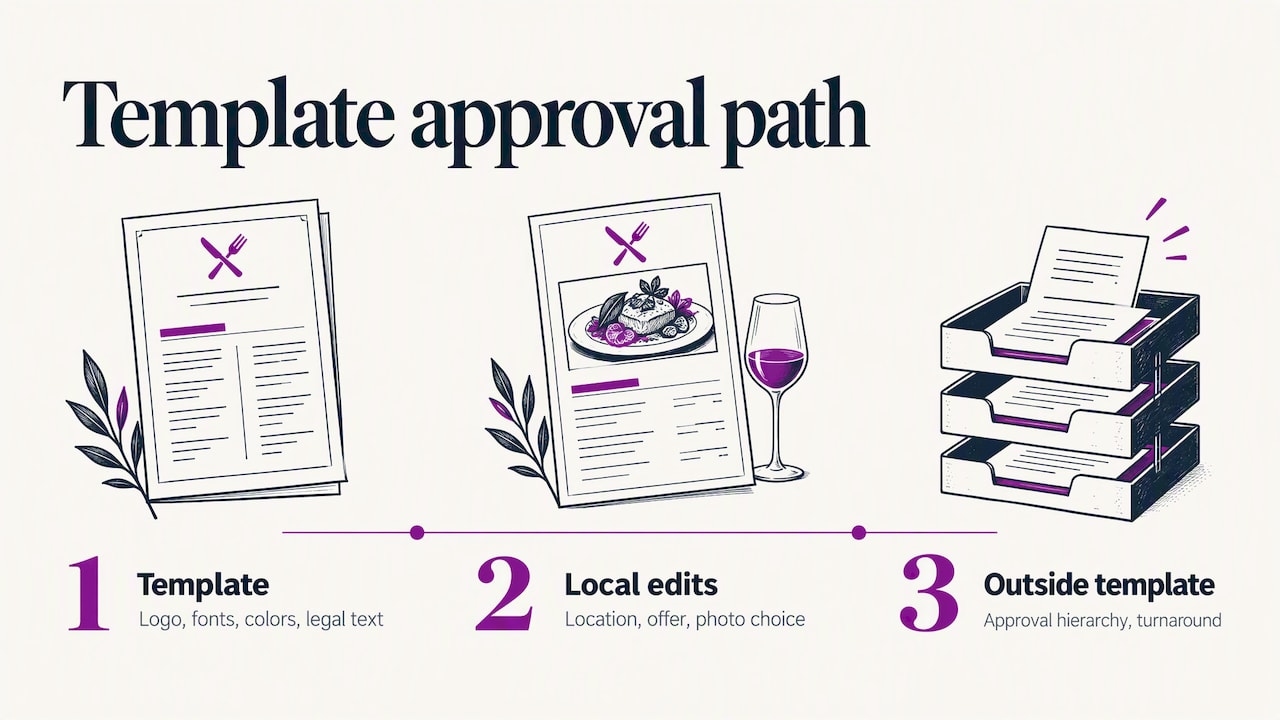
Franchisees want to customize. Corporate wants to protect the brand. If every local request goes through email, both sides lose. A better pattern is to pre-approve templates with locked elements (logo, fonts, colors, legal text) and open fields (location, offer details, photo choice). Anything outside the template follows a defined approval hierarchy with clear turnaround expectations. Our overview of localized marketing campaigns explains how to set up that structure.
Money is opaque
Most franchise systems fund marketing through a mix of national fund contributions, local spend requirements and sometimes vendor or supplier support. When franchisees cannot see where their contributions go, engagement drops. When corporate cannot see what local owners spend, brand standards slip. Budget visibility in both directions, plus the regular reviews that Freddy’s describes, makes the system feel fair. For brands that also work with suppliers and vendors, we cover the model in our guides on co-op fund management and vendor management for channel networks.
The common thread is infrastructure. One restaurant-industry case study makes the point plainly, arguing that for a brand scaling quickly, systems beat big-idea creative. We agree: a good idea that cannot reach 500 locations in a week is just a good idea.
Measuring what works at the location level
Totals hide problems. A system-wide sales lift can mask a dozen stores that did not participate. Measure at three levels:
- Location. Which stores ran the campaign, what they spent and what changed in traffic and sales compared with their own history.
- Region or franchisee group. Which markets respond best to which offers, so budget follows results.
- System. The overall return on national spend, using an approach you can repeat.
Some practical habits make this easier. Give each local social post and online-ordering link its own tracking parameters, so online revenue can be traced back to the source. Compare return on ad spend by region instead of only in aggregate. Look at customer acquisition cost and lifetime value by segment rather than one blended number.
Brands that measure well can also make the case internally. Domino’s UK reported, in its Marketing Society case study, that econometric modelling credited its communications with £230m of incremental revenue between the 2013 launch of its Greatness campaign and March 2016. It also reported marketing profit ROI rising every year to 31% in 2016, which it put at an average of £287,000 of profit back to each franchisee since 2014. The numbers are specific to that brand and period, but the lesson travels: when franchisees can see a return, they take part.
Common challenges and how to handle them
| Challenge | What it looks like | What helps |
|---|---|---|
| Coordination across locations | Different offers and dates from store to store | One campaign calendar visible to everyone |
| Localization | Generic national creative that ignores the neighborhood | Templates with editable local fields |
| Slow approvals | Owners give up and build their own materials | Pre-approved templates, defined turnaround times |
| Low franchisee engagement | Toolkits go unused | Short training, quarterly calls, easy-to-use tools |
| Performance tracking | No view of what each store actually did | Unit-level reporting and regional comparison |
Treat each store as its own micro-market, with its own competitors, traffic patterns and customer mix. Then ask what support it needs, rather than assuming the national plan fits.
Our perspective: logistics comes before creativity
We have spent more than 20 years helping brands that sell through other people, and restaurant franchisors face the same pattern we see in dealer and distributor networks. The brand team knows what good looks like. The local operator wants to promote their restaurant this week. Between them sits a tangle of email threads, shared drives, agency requests and spreadsheets.
Our view is that marketing logistics is the discipline most franchise systems underinvest in. When we automated menus for nearly 2,000 Applebee’s locations, the win was not a new idea. It was getting the right menu to the right place without manual work at each restaurant. You can read how that played out in our Applebee’s case study.
We also believe control and speed are not trade-offs. A franchisor can lock the brand elements that matter and still give owners a fast path to what they need. Franchisees will follow a system that saves them time. They will route around one that slows them down.
— Client
Bringing it together on one platform
GearBox® is our marketing logistics platform for brands that market and sell through franchisees, dealers, distributors and other partners. It puts campaigns, assets, vendors, funds and orders behind one login, so corporate keeps control of the brand and budget while each local operator gets the materials and tools to market their own location.
For restaurant and franchise brands, that means approved templates and asset libraries, approval hierarchies, campaign calendars, order tracking, collateral fulfillment and analytics, plus support for multilingual and multicurrency programs. Converge® handles global-to-local marketing, so one national idea can be adapted for each market without starting over.
If you are weighing how to launch new units with marketing that is ready on day one, see how we launch franchises faster, or read about our franchise local marketing platform. When you are ready to see it working for your network, schedule a demo of GearBox®.
A practical starting plan
You do not need to rebuild everything at once. A sensible sequence:
- Audit what exists. List every asset, template, approval path and budget source. Note where franchisees currently go for materials.
- Define the lanes. Write down what corporate owns, what franchisees own and what needs approval. Keep it to one page.
- Build the toolkit. Start with the five materials franchisees ask for most, as templates with locked brand elements and editable local fields.
- Set a rhythm. Quarterly calls and budget reviews, as the franchisors above describe, keep the partnership honest.
- Measure by location. Start with a simple scorecard per store and compare within regions.
- Fix the weakest links. Look at stores below their region’s norm and investigate local search, listings and reviews first.
For a wider view of how this applies beyond restaurants, our pieces on multi-location digital marketing and multi-location management are good next steps.
FAQ
How do I do marketing for my restaurant?
Start with the basics that bring in local guests: an accurate Google listing, a current menu, good photos and a steady stream of reviews. Then add one or two channels you can sustain, such as local social posts, email or loyalty offers. If you are part of a franchise, ask your franchisor for the approved toolkit before building your own materials.
What is the difference between franchise marketing and restaurant marketing?
Restaurant marketing focuses on bringing guests to a specific location. Franchise marketing adds a second layer: protecting one brand across many owners, and in some cases recruiting new franchisees. That is why franchise systems need approval paths, shared assets and clear budget rules.
Who pays for marketing in a restaurant franchise?
That depends on the franchise agreement. Many systems combine a national marketing fund contribution with required local spend, so the contract and the franchise disclosure document are the places to check the exact structure. Regular budget reviews help franchisees see how their money is used.
How do franchisors keep local marketing on brand?
The most common approach is pre-approved templates with locked brand elements, a central asset library and a defined approval route for anything custom. This gives owners speed and gives corporate confidence that fonts, colors and messaging stay consistent.
Sources
- Marketing Byte: Looking at the Greatest Current Challenges in Marketing, Franchise Update Media
- CMO Roundtable with Ashley Mitchell, East Coast Wings + Grill
- How Keke’s Breakfast Cafe builds local demand through national marketing leadership
- CMO Roundtable with Erin Walter, Freddy’s Frozen Custard & Steakburgers
- Influencer marketing: it’s all about the buzz, National Restaurant Association
- Restaurant 2030 report, National Restaurant Association
- Domino’s: The Journey to Greatness, The Marketing Society
- Local SEO, AEO and GEO Academy
