



MDF fund management is the work of setting up, approving, paying out and measuring market development funds: the money a brand gives its dealers, distributors, franchisees or resellers to market the brand’s products locally. Done well, it means every dollar is tied to an approved activity, a claim with proof, and a result you can report. Done badly, it means unused budgets, slow reimbursements and partners who stop asking.
This guide covers how MDF programs are structured, which guidelines keep them clean, how the claim process works step by step, how to measure results, and when a spreadsheet stops being enough.
TL;DR
- Market development funds (MDF) are vendor-funded marketing budgets that channel partners use to promote the vendor’s products, usually reimbursed after the work is done and documented.
- Clear program guidelines, written pre-approval and a firm claim window prevent most disputes before they start.
- A claim needs proof of performance: invoices, photos, samples or certifications that show the approved activity actually happened.
- Utilization alone is a weak measure. Track pipeline, revenue and win rate by partner and activity, then move funds toward what works.
- Once you manage dozens of partners or several vendors’ funds, a single system for requests, approvals, claims and reporting beats email and spreadsheets.
Table of Contents
- What MDF fund management actually involves
- How MDF programs are structured
- MDF program guidelines that prevent problems
- The MDF claim process, step by step
- Measuring MDF: from utilization to results
- Common MDF challenges and how to fix them
- When to move from spreadsheets to MDF software
- Our perspective: MDF is a logistics problem
- How GearBox® handles MDF and co-op funds
- A starter checklist for your MDF program
- FAQ
- Sources
What MDF fund management actually involves
Market development funds go by several names: MDF, marketing development funds, co-op funds. They share one idea. A manufacturer or vendor sets money aside so its channel partners can run marketing that builds demand for the vendor’s products. The partner does the local work, and the vendor pays for part or all of it.
Managing that money is more than writing checks. It covers five jobs:
- Allocation: deciding how much each partner or region can access, and on what basis.
- Guidelines: defining which activities and expenses qualify.
- Approval: reviewing requests before money is spent.
- Claims and payment: verifying proof and reimbursing eligible costs.
- Measurement: connecting funded activity to leads, sales and brand outcomes.
Most programs fail at the seams between these jobs, not within one of them. A generous allocation with confusing guidelines produces rejected claims. Fast approvals with no measurement produce spending that nobody can defend at budget time. For a broader primer on the concept, see our guide to what MDF is for distributed brands.
How MDF programs are structured
There is no single standard. Three structures show up most often, and many brands mix them.
| Structure | How money moves | Best for | Main risk |
|---|---|---|---|
| Reimbursement | Partner spends first, submits proof, vendor repays approved costs | Brands that want tight control over what is funded | Partners with thin cash flow hesitate to participate |
| Rebate | Funds are earned and paid after agreed sales or performance milestones | Programs tied to volume or growth targets | Weak link to specific marketing activity |
| Shared (co-op) funding | Vendor and partner split the cost of an activity, with invoices as evidence | Local advertising, events, in-store and digital campaigns | Accrual rules and match percentages need constant policing |
How you allocate is a separate decision. Common methods include a percentage of partner purchases or sales, a flat amount per tier in the partner program, or a discretionary pool awarded by application. Accrual-based funds reward volume. Discretionary pools reward good plans. Many brands use accrual for baseline funds and a discretionary pool to back the best ideas.
If you sell through distributors, there is a twist: the money often flows the other way. Distributors hold relationships with many vendors and decide where to spend their own marketing effort. Our advanced MDF management approach covers that case, including how vendors can compete for distributor attention with funded programs.
MDF program guidelines that prevent problems
The guidelines document is the most valuable single asset in an MDF program. It is what a partner reads before spending a dollar and what your team cites when a claim is rejected. A good one is short, specific and enforced.
Define what qualifies
List the activity types you will fund, and the ones you will not. Typical funded categories include digital advertising, events and trade shows, direct mail, signage and point-of-sale materials, co-branded collateral, training and lead-generation campaigns. Typical exclusions include partner payroll, general overhead, travel unrelated to the activity, and promotion of competing products.
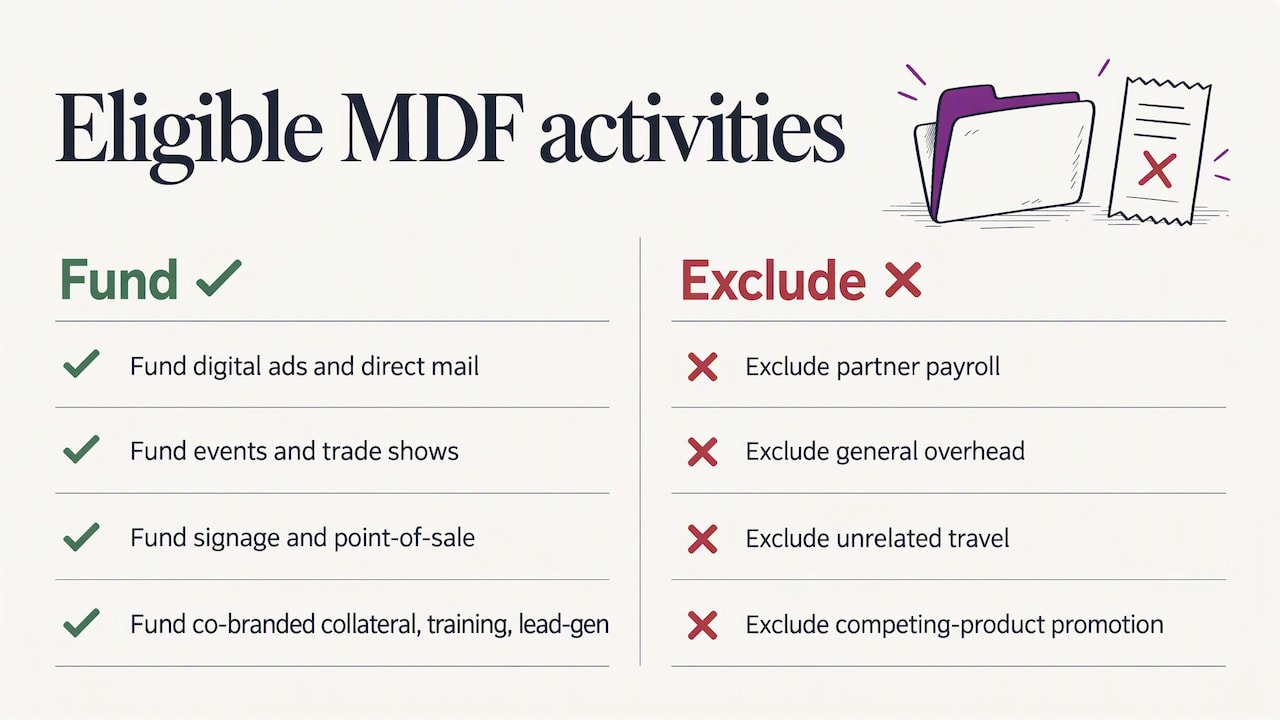
NetSuite’s guidance on MDF makes the same point: vendors should define generally accepted qualifying activities and measure ROI granularly, so the indirect financial support given to partners can be quantified. If a partner cannot tell from your document whether an expense is eligible, the guidelines are not finished.
Require pre-approval in writing
The cleanest rule in MDF is also the strictest: no approval, no reimbursement. Pega’s partner guide, for example, requires advance approval for all MDF activities and rejects claims for activities not pre-approved in writing. You do not have to copy that wording, but you do need a rule like it. Retroactive approvals teach partners that the process is optional and make budget forecasting guesswork.
Set brand and co-branding requirements
Say which logos, claims, legal disclaimers and templates are mandatory. For brands with many local partners, the practical solution is to give partners approved templates they can customize rather than asking them to design from scratch and then rejecting the result. That is the idea behind localized marketing solutions: corporate fixes the brand elements, the local partner edits the parts that should be local.
Fix the dates and the limits
Publish the fiscal period funds are valid for, the deadline for submitting requests, the claim window after the activity ends, and the maximum share of each activity the vendor will cover. Say what happens to unused funds: expire, roll over or return to a shared pool. Ambiguity here produces the end-of-year scramble where partners spend to avoid losing money and quality suffers.
Write down who decides
Name the role that approves requests, the role that verifies claims and the escalation path for disputes. Where several vendors, regions or business units contribute to a partner’s budget, approval hierarchies matter as much as the rules themselves.
The MDF claim process, step by step
The claim process is where partners decide whether your program is worth the effort. It should be predictable and fast. The sequence most programs follow looks like this.
- The partner submits a request. It describes the activity, dates, target audience, expected outcome, total cost and the amount of MDF requested.
- The vendor reviews and approves. The reviewer checks eligibility, budget availability and brand compliance. The approval is recorded, ideally with a fund amount reserved.
- The partner runs the activity. Any change to scope or budget goes back through approval.
- The partner files a claim. Pega’s guide describes filing a claim with proof of performance and receipts within 60 days of the approved activity. Your window may differ, but it should be explicit.
- The vendor verifies the documentation. The reviewer matches proof to the approved request and checks that costs are eligible.
- Payment is issued. The partner is reimbursed for eligible approved expenses, by check, ACH, credit memo or account credit, depending on the program.
- Results are logged. Leads, orders or other outcomes are recorded against the activity.
What counts as proof of performance
The same Pega guide says reimbursement depends on proof of performance, which may include photos, vendor invoices, sample content or certifications. In practice, match the proof to the activity:
| Activity | Typical proof |
|---|---|
| Digital advertising | Platform invoice, screenshots of live ads, campaign report |
| Event or trade show | Vendor invoices, photos of the booth or venue, attendee list |
| Direct mail | Printer and postage invoices, a sample piece, mailing list count |
| Signage and in-store | Fabrication invoice, dated photos of installed display |
| Training | Attendance records, certificates, trainer invoice |
Tell partners the proof requirements at the time of approval, not at the time of the claim. A partner who learns after the event that a screenshot was needed cannot go back and take it.
Common reasons claims are rejected
- The activity was not pre-approved.
- The claim was filed after the deadline.
- Invoices do not match the approved amount or vendor.
- Proof shows missing or outdated brand elements.
- The expense falls in an excluded category.
Every one of these is predictable. Publish the list and most of them go away.
Keep turnaround short
Partners fund activities from their own cash until reimbursement arrives. Set an internal target for how long review and payment take, and measure it. Long cycles are a quiet killer of participation, especially among smaller dealers and franchisees who cannot float large campaigns.
Measuring MDF: from utilization to results
The most common MDF metric is utilization: the share of allocated funds that partners claimed. It is easy to calculate and tempting to celebrate. It is also incomplete. Spending an entire allocation says nothing about whether the spending worked. Analysis from channel marketing practitioners makes this argument directly: raw utilization is not enough, and teams should look for evidence-backed pipeline contribution instead.
A better scorecard has three layers.
Program health
- Utilization by partner, region and tier
- Share of partners who requested funds at all
- Time from request to approval, and from claim to payment
- Claim rejection rate and the top rejection reasons
Activity performance
- Leads, orders or foot traffic attributed to each funded activity
- Cost per lead and cost per sale by activity type
- Which partners consistently deliver results on the same budget
Business impact
- Sourced or influenced pipeline and revenue tied to MDF
- Win rate on opportunities touched by funded campaigns
- Growth in partner sales compared with unfunded partners of similar size
The measurement only works if you connect funded activity to the systems where leads and sales are recorded. For brands with local campaigns, we cover the practical mechanics in how to track local campaign ROI. Review the numbers quarterly, retire activity types that do not perform, and shift next period’s discretionary funds toward partners and plays with proven results. Sales should share accountability for the numbers, since marketing alone cannot close the loop.
Common MDF challenges and how to fix them
Funds go unused. Partners often do not know funds exist, find the process heavy, or cannot see their balance. Fix it with a simple partner portal view of available funds, pre-built campaign templates and a regular reminder cadence. A catalog of approved, ready-to-run campaigns lowers the effort of applying to almost nothing.
Manual administration swamps the team. When requests arrive by email and claims live in spreadsheets, one person’s vacation stalls the program. Standard forms, routing rules and automated reminders do most of the work. If you are early in this journey, a marketing automation checklist is a useful way to map which repetitive steps to automate first.
Brand drift at the local level. Partners improvise logos, offers and claims. The answer is not more policing but better tools: approved assets, locked brand elements and review before anything prints or publishes.
Multiple vendors, multiple rulebooks. Distributors and dealers that carry many brands face a different process for each. Where one organization manages many vendors’ funds, such as a distributor, a consistent system with vendor-level rules saves everyone time.
No link to revenue. If outcomes are not captured at the time of the claim, they are almost impossible to reconstruct later. Make a short results field part of the claim itself.
When to move from spreadsheets to MDF software
A spreadsheet and a shared inbox can run a program with a handful of partners. The cracks appear when you have any of the following:
- More than a few dozen partners, or multiple tiers with different rules
- Funds from several vendors, regions or business units flowing to one partner
- Requirements to prove compliance or audit spend
- Partners asking for balances and claim status in real time
- Leadership asking for ROI by activity and the answer takes a week to assemble
MDF software is meant to handle the whole life cycle in one place: fund allocation, partner requests, approval routing, proof-of-performance review, reimbursement and reporting. The features that matter most:
- Fund visibility: partners and administrators see balances, commitments and spend at any time.
- Configurable workflows: different approval paths by amount, activity type or region.
- Claim handling: structured upload of invoices and proof, with checks against the original request.
- Asset and campaign tools: approved creative, templates and fulfillment so funded activity stays on brand.
- Reporting: results by partner, program and activity, available without a data-pull project.
- Integrations: connections to your asset library, CRM and finance systems.
If you want to see how this fits into the larger picture, read our piece on channel marketing automation and our guide to channel partner budgeting and incentives.
Our perspective: MDF is a logistics problem
After more than 20 years working with brands that sell through dealers, distributors, franchisees, agents and advisors, we see the same pattern. Companies treat MDF as a finance problem or a partner-relations problem. It is neither. It is a logistics problem: getting the right budget, the right approved assets and the right vendor to the right local partner at the right time, with a record of what happened.
That is why we built GearBox® as a marketing logistics platform rather than a standalone claims tool. Funds are only one input into local marketing. Partners also need creative they can use, vendors who can print and ship, an order trail and a place to see approvals. When those live in separate systems, partners route around them, and corporate loses both control and visibility.
Our view is that the best MDF programs give corporate control of the brand and the budget while making the partner’s path as short as possible. If a local marketer can pick an approved campaign, customize it, see the fund balance and place the order from one login, they will use the program. If they cannot, no guideline document will save it.
— Client
How GearBox® handles MDF and co-op funds
GearBox® puts campaigns, vendors, co-op and MDF dollars, orders and brand assets behind one login. Its co-op and MDF fund management module supports approval hierarchies, payments and sales tax, and it includes a Reverse Co-op Engagement Tool for distributors. It also connects with Adobe DAM and Widen for asset management and supports multilingual and multicurrency programs.
Brands use it at scale. SRS Distribution added more than $2 million a year in co-op fund use across 70+ vendors, and Steelcase runs 15,000+ users in 9 countries on the platform. You can read more on our pages about co-op fund management and streamlining co-op fund management to maximize ROI.

If your program is outgrowing spreadsheets, schedule a GearBox® demo and we will walk through your fund structure, approval rules and reporting needs with you.
A starter checklist for your MDF program
Use this list to audit your current setup, or to launch a new program.
- Write a one- to two-page guidelines document: eligible activities, exclusions, brand rules, dates and limits.
- Choose your structure (reimbursement, rebate, co-op) and allocation method, and explain both to partners.
- Require written pre-approval for every funded activity.
- Publish proof-of-performance requirements per activity type.
- Set a claim deadline and an internal target for review and payment time.
- Provide approved templates and assets so compliance is the easy path.
- Capture a results field on every claim.
- Review utilization and outcomes quarterly, then reallocate.
- Decide when volume justifies moving to software, and what integrations it needs.
Industry specifics change the details. Our MDF guide by industry shows how building products, manufacturing, franchise and other sectors adapt the same basics.
FAQ
What does MDF stand for, and who pays for it?
MDF stands for market development funds, also called marketing development funds. The vendor or manufacturer pays, setting aside budget so channel partners such as resellers, dealers or distributors can promote its products. The partner usually spends first and is reimbursed for approved costs.
How long do partners have to submit an MDF claim?
It depends on the program. Pega’s partner guide, for example, sets a 60-day window to file a claim with proof of performance and receipts. Whatever window you choose, state it in the guidelines and in each approval.
What is the difference between MDF and co-op funds?
The terms overlap, and many brands use them interchangeably. Co-op typically describes funds that accrue from partner purchases and are matched with partner spending. MDF is often a broader or discretionary pool for partner marketing, though the rules depend on the vendor.
What does MDF software do?
It manages the whole fund life cycle in one system: allocations, partner requests, approvals, claims with proof, reimbursement and reporting. Good platforms also connect to asset libraries and CRM data so you can tie spending to results.
Can small programs manage MDF without software?
Yes, when there are few partners and simple rules. Standard forms, a shared tracker and a clear guidelines document go a long way. Move to software when claim volume, multiple funding sources or reporting demands start consuming more time than the marketing itself.
Sources
- Partner Market Development Funds (MDF) Guide, Pega Partners
- Optimizing MDF for Your Partner Sellers, NetSuite
